
 WhatsApp
Construction aggregates—including sand, gravel, crushed stone, slag, and recycled concrete—are the foundational building blocks that provide strength, stability, and durability to modern infrastructure. Aggregates typically occupy 60-75% of concrete volume and constitute over 90% of asphalt mix by weight, making them the most volumetrically significant construction material globally.
From skyscraper foundations and highway pavements to railway ballast, drainage systems, and decorative landscaping, aggregates serve critical structural and functional roles across all project scales—whether you are building a garden path or a national highway network.
This guide delivers a practical, data-driven overview for quarry operators, civil engineers, and procurement managers. We break down:
This guide delivers a practical, data-driven overview for quarry operators, civil engineers, and procurement managers. We break down:
- Types – natural, recycled, and manufactured aggregates – and a side-by-side comparison of their sources, strengths, and best-fit applications.
- Production – a step-by-step walkthrough from quarry extraction and primary crushing to screening, washing, and final quality assurance.
- Applications – how aggregates perform in concrete, asphalt, road sub-bases, railway ballast, drainage systems, and decorative landscaping.
- Key properties – what makes a "good" aggregate: grading, shape and texture, strength, and durability, with standard test methods and acceptance criteria.
- Sustainable practices – how recycled and manufactured aggregates support circular economy goals while reducing project costs.
By the end, you will understand how to select the right aggregate for your specific project—balancing performance, cost, and sustainability.
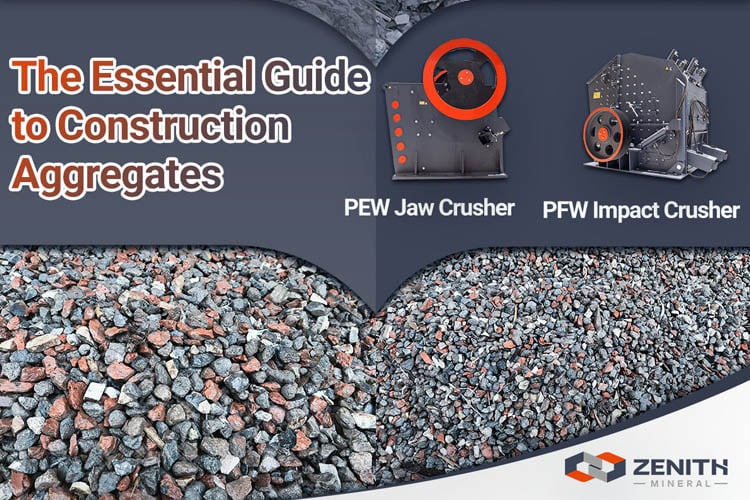
What Are Construction Aggregates?
Construction aggregate is a broad category of particulate materials used as a foundational component in construction. It serves primarily as a filler and reinforcement material. When bound together by a medium like cement or bitumen, aggregates create strong, durable composites that can withstand immense loads and environmental stresses. Their role in construction is dual: they provide essential structural integrity to materials like concrete and asphalt, and they offer functional benefits such as drainage and weight distribution in foundations and road bases.
According to international aggregate standards such as ASTM C33 and EN 12620, aggregates are structurally categorized by particle size into two principal fractions:
- Fine Aggregate (Sand): Particles passing through a 4.75 mm (US Standard No. 4 Sieve) down to 0.075 mm (75 µm / Mesh #200).
- Coarse Aggregate (Crushed Stone / Gravel): Particles retained on a 4.75 mm (US Standard No. 4 Sieve) up to 37.5 mm or larger.
The Three Main Types of Aggregates Used in Construction
Aggregates are typically classified into three categories based on their source and production method: natural aggregates, recycled aggregates, and manufactured aggregates. Selecting the right type is crucial for meeting project specifications for strength, durability, and sustainability.
| Type | Source | Common Materials | Key Strength | Best Applications |
|---|---|---|---|---|
| Natural | Quarried deposits | Sand, gravel, crushed stone | High compressive strength, consistent grading | Concrete mixes, asphalt, road sub-base, drainage |
| Recycled | Processed C&D waste | Crushed concrete, reclaimed asphalt | Cost-effective, sustainable, diverts landfill waste | Road sub-base, backfill, bulk fill, non-structural concrete |
| Manufactured | Industrial by-products | Steel slag, expanded clay, fly ash | Engineered properties (lightweight, high-strength) | Lightweight concrete, insulation, specialized road base |
1. Natural Aggregates
Extracted directly from natural riverbeds, alluvial deposits, or open-pit quarries, natural aggregates represent the most traditional fine and coarse construction media:
- Natural Sand: A fine aggregate essential for concrete, mortar, and rendering.
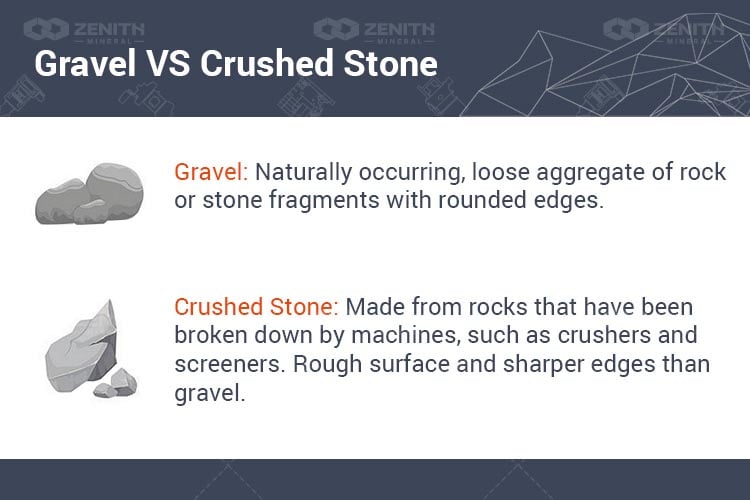
- Gravel: A coarse aggregate typically used in concrete mixes, drainage systems, and as a decorative material.
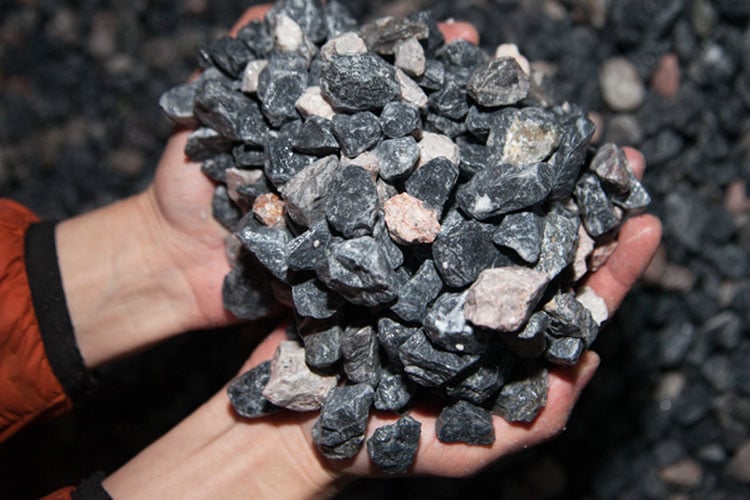
- Crushed Stone: Produced by mechanically blasting and crushing large quarry rocks (granite, limestone, basalt) in primary jaw crushers and secondary cone crushers. It forms the backbone of structural concrete, asphalt wear layers, and highway road bases.
2. Recycled Aggregates
Produced from reprocessed construction and demolition waste, these materials support a circular economy.
- Recycled Concrete Aggregate (RCA): Produced by crushing demolished concrete structures; heavily reused as eco-friendly highway sub-base material, trench backfill, and pipe bedding.
- Reclaimed Asphalt Pavement (RAP): Reprocessed asphalt pavement is frequently used in new road construction and repairs.
Benefits of Recycled Aggregates: Diverts millions of tons of waste from landfills, conserves virgin quarry resources, and delivers up to 15%–20% in material cost savings for municipal projects.
3. Manufactured Aggregates
Engineered through industrial processing or manufactured from crushed quarry fines, these materials offer controlled particle shapes, custom gradations, and specialized physical properties:
- Manufactured Sand (M-Sand): Produced by fine-crushing hard rock using Vertical Shaft Impactors (VSI sand makers). M-Sand features cubical particles and controlled fineness modulus (FM), serving as a premier, sustainable 100% replacement for depleted natural river sand in structural concrete.
- Air-Cooled Blast Furnace Slag: A dense byproduct of iron and steel production, widely specified for mass concrete, heavy-duty asphalt wearing courses, and road sub-base stabilization due to its exceptional skid resistance and chemical durability.
- Expanded Clay & Shale: Lightweight aggregates produced by pyro-processing raw clay in rotary kilns at high temperatures. Essential for structural lightweight concrete blocks, precast roof panels, high-rise insulation, and horticultural drainage.
How Construction Aggregates Are Made: Crushing, Screening & Washing Guide
The transformation of solid bedrock into precisely graded, cubic aggregates is a multi-stage process governed by strict civil engineering specifications. Modern crushing, screening, and sand-washing circuits ensure consistency, cleanliness, and structural strength across four primary production phases:
E-Books:Aggregates Production Solutions for Quarries
Phase 1: Site Preparation & Extraction
The process begins long before the first blast, with extensive geological surveys to identify a suitable deposit. Once a site is selected, the overburden—the layer of soil, vegetation, and unusable rock covering the desired stone—is carefully removed and stored for future site rehabilitation.
The extraction itself typically employs controlled blasting. Engineers drill a precise pattern of holes into the bedrock, which are filled with carefully measured explosives. The goal is not to pulverize the rock, but to fracture it into large, manageable boulders known as shot rock. This method maximizes yield while minimizing vibration and environmental impact.
Phase 2: Multi-Stage Crushing Circuits
Heavy-duty off-highway haul trucks transport shot rock from the quarry face to the primary processing plant for progressive size reduction:
- Primary Crushing (Jaw / Gyratory Crushers): Massive primary Jaw Crushers or Gyratory Crushers apply intense compressive force to break 1-meter boulders down to 150–250 mm coarse feed.
- Secondary Crushing (Cone / Impact Crushers): Material is conveyed to heavy-duty Cone Crushers or Impact Crushers to further reduce rock size down to 20–50 mm.
- Tertiary Shaping & Sand Making (VSI Crushers): To optimize aggregate cubicity and produce high-grade Manufactured Sand (M-Sand), Vertical Shaft Impactors (VSI) utilize high-speed rock-on-rock collision to eliminate flat or elongated particles, ensuring superior particle interlock for concrete.
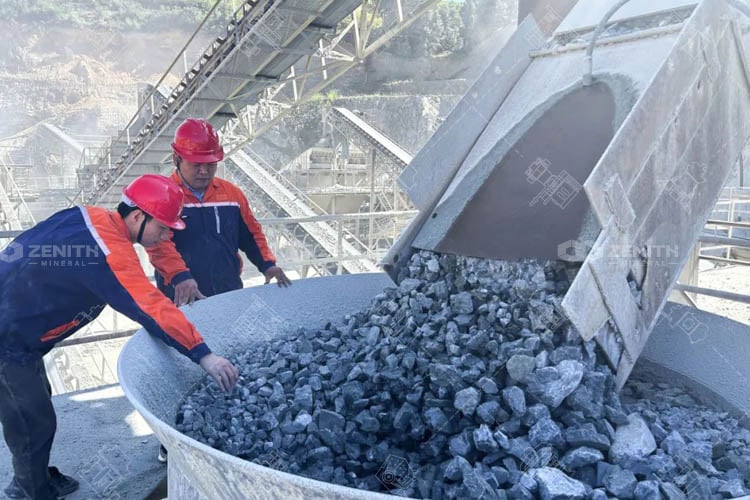
Phase 3: The Critical Steps of Screening, Washing, and Classification
This is the heart of quality control, where raw crushed stone is transformed into a specified product.
- Screening: The crushed material is conveyed to a vibrating screening plant. This machine, equipped with a series of screens or meshes with progressively smaller openings, acts like a giant set of sieves. It mechanically sorts the aggregate into distinct, graded piles based on particle size (e.g., 0-5mm fine aggregate, 10-20mm coarse aggregate, 40-75mm drainage stone).
- Washing: Simultaneously or immediately after screening, aggregates are often washed in log washers or scrubber drums. High-pressure water jets remove deleterious materials such as clay, silt, light organic matter, and fine dust that coat the stone. This is crucial because these impurities can severely weaken the bond between aggregate and cement in concrete or asphalt.
- Final Sorting & Stockpiling: The clean, sized aggregates are conveyed to separate stockpiles. Modern plants use radial stacker conveyors to build organized, non-segregated piles. Each stockpile is clearly labeled with its product specification.
Phase 4: Quality Assurance & Dispatch
Before leaving the quarry, certified technicians collect representative samples from each stockpile to undergo rigorous laboratory testing according to ASTM C33 and EN 12620 standards:
- Sieve Analysis (Gradation): Verifies particle size distribution curves.
- LA Abrasion & Impact Value: Measures mechanical strength and resistance to crushing under heavy loads.
- Flakiness & Elongation Index: Ensures particle cubicity for optimal concrete workability.
- Clay Lumps & Deleterious Fines: Confirms cleanliness and absence of organic impurities.
Upon passing QA/QC clearance, certified aggregates are loaded onto haul trucks, railcars, or barges, accompanied by shipping manifests and lab certified test reports guaranteeing quality from the quarry to the construction site.
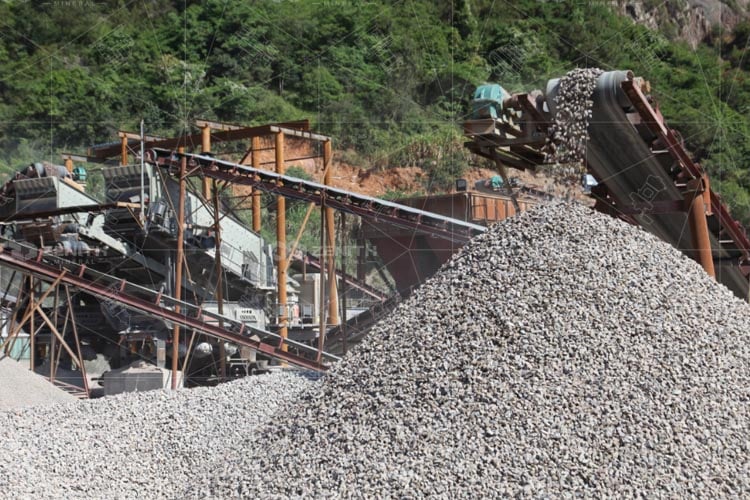
What Are Construction Aggregates Used For?
Construction aggregates—encompassing materials like sand, gravel, crushed stone, and their recycled counterparts—are far more than just filler. They are the fundamental backbone of modern infrastructure and development. While their role in concrete is well-known, their applications are remarkably diverse, providing critical functions from the deepest foundations to decorative surfaces and even environmental protection.
1. Structural & Civil Engineering: Concrete, Asphalt & Infrastructure
This is the most volumetrically significant use of aggregates, where their strength and stability are paramount.
- Concrete Production: Aggregates typically make up 60-75% of concrete's volume. They provide bulk, dimensional stability, and critically, compressive strength. Fine aggregates like sand fill voids between coarse aggregates (gravel or crushed stone), creating a dense, load-bearing matrix when bound by cement.
- Asphalt for Roadways: In asphalt concrete, aggregates constitute over 90% of the mix by weight. They are bound together by bitumen to create a flexible, durable, and skid-resistant surface capable of withstanding relentless traffic loads and weather extremes.
- Road and Railway Foundations (Sub-bases): Before any pavement or track is laid, a stable foundation is essential. Layers of compacted, larger-sized aggregates (e.g., 40mm or 75mm crushed stone) create a load-distributing platform. This "sub-base" prevents deformation of the soft ground below, ensures drainage, and is crucial for the longevity of the surface above. Specific graded materials like MOT Type 1 are engineered for this purpose.
- Railway Ballast: The bed of coarse, angular crushed stone (often 40-75mm) surrounding railway ties serves multiple vital functions: it anchors the track, distributes immense train loads, facilitates drainage to prevent washouts, and dampens vibration and noise.
2. Shaping and Protecting the Landscape: Geotechnical and Environmental Applications
Here, aggregates solve physical challenges related to earth and water.
- Coastal and Riverbank Defense (Rip Rap & Rock Armour): Large, durable stones (150mm and larger, known as rip rap or rock armour) are used to armour shorelines, bridge abutments, and embankments. Their primary function is to absorb and dissipate the energy of waves or flowing water, preventing erosion and protecting critical infrastructure.
- Gabion Retaining Structures: These are wire mesh cages filled with stone (often 100-150mm gabion stone). Used in retaining walls, riverbank revetments, and coastal defenses, gabions are flexible, permeable, and exceptionally strong. They stabilize slopes while allowing water to flow through, reducing hydrostatic pressure.
- Drainage and Filtration Systems: Clean, washed aggregates of specific sizes are ideal for drainage. They are used as pipe bedding in trenches, as the fill material in French drains to divert groundwater, and in filter beds for wastewater treatment, where their void spaces allow water to pass while filtering particulates.
3. Building Construction: Foundations, Backfill & Piling Mats
Aggregates are essential from the ground up in all types of buildings.
- Building Foundations and Floor Slabs: A layer of compacted aggregate is the first step after excavation. It provides a level, stable, and well-draining base for concrete footings and slabs, preventing settling and moisture damage.
- Utility and Service Trenches: Aggregates like 6F2 or 6F5 recycled material are commonly used as backfill around pipes and cables. They offer good compaction and support while being cost-effective for these "hidden" applications.
- Piling Mats: On soft construction sites, a thick layer of coarse aggregate (like 6F2) is laid down to create a stable working platform for heavy piling rigs and cranes.
4. Landscaping & Hardscaping: Driveways, Patios & Decorative Gravel
In architectural and landscaping design, the aesthetic qualities of aggregates—particle color, texture, shape, and permeability—take priority:
- Pathways, Driveways & Paver Patios: Decorative gravels, crushed granite, and exposed aggregate concrete deliver attractive, permeable, low-maintenance surfaces for residential hardscaping (typically 10 mm to 20 mm sizing).
- Garden Beds & Soil Conditioning: Colored pea gravel, slate chippings, and washed river cobbles serve as weed-suppressing mulches, soil moisture retainers, and decorative garden features.
- Exposed Aggregate Architectural Finishes: Surface-washed decorative concrete exposes underlying colorful aggregates, yielding durable, non-slip, textured finishes for pedestrian plazas and building facades.
5. The Sustainable Solution: Applications for Recycled Aggregates
The use of recycled aggregates is a cornerstone of the circular economy in construction, diverting waste from landfill.
- Road Sub-base and Hardcore: Recycled crushed concrete and asphalt are perfectly suited as a high-quality, unbound sub-base material for new roads, car parks, and site access tracks.
- General Fill and Bulk Material: For non-structural filling applications, such as raising site levels or filling old basements, recycled aggregates offer a cost-effective and environmentally responsible alternative to virgin material.
- Structural Concrete Replacement: Advanced washing and screening allows high-grade recycled concrete aggregate to replace up to 20%–30% of natural aggregate in specified structural concrete mixes.
Crucial Properties: What Makes a High-Quality Aggregate?
Aggregate performance in concrete, asphalt, or drainage systems depends on three core physical and mechanical properties: grading, shape & texture, and strength & durability.
1. Particle Size Grading & Fineness Modulus (FM)
Grading defines the particle size distribution curve of an aggregate batch. A well-graded aggregate mix contains a balanced progression of particle sizes, minimizing void space between stones and reducing the volume of expensive cement paste required:
- Fine Aggregate Grading: Evaluated by its Fineness Modulus (FM), typically required to fall between 2.3 and 3.1 for structural concrete sand.
- Coarse Aggregate Grading: Standardized fractions (e.g., 5–10 mm, 10–20 mm, 20–40 mm) are blended to ensure continuous gradation without gap-grading voids.
2. Particle Shape & Surface Texture
The physical geometry and surface roughness of aggregate particles directly influence fresh concrete workability and hardened mechanical interlock:
- Angular & Rough Particles (Crushed Stone): Provide superior mechanical interlocking and strong bonding with cement paste, yielding higher compressive and flexural strength. However, they slightly increase water demand.
- Rounded & Smooth Particles (River Gravel): Offer lower friction, significantly improving fresh concrete slump and workability, but provide lower mechanical interlock.
- Flakiness & Elongation Index: Flat or needle-like particles easily crack under heavy compaction and increase void space. High-quality structural aggregates restrict flaky and elongated particles to below 15%–20%.
3. Mechanical Strength & Resistance to Weathering
Aggregates must withstand severe mechanical crushing, traffic abrasion, and long-term environmental weathering:
- LA Abrasion Resistance: Evaluates hardness and resistance to mechanical wear using the Los Angeles Abrasion Test (ASTM C131). High-grade aggregates for asphalt wearing courses and railway ballast typically require an LA abrasion loss value under 25%–30%.
- Freeze-Thaw Soundness: Measures resistance to disintegration caused by freeze-thaw cycles and pore-water expansion (tested via sodium or magnesium sulfate soundness tests).
- Compressive & Impact Value: Ensures the stone resists fracturing under heavy dynamic traffic loads or high-rise building dead-loads.
4. Cleanliness & Moisture Condition
The presence of fine contaminants or unmonitored moisture drastically alters concrete water-cement ratios and bond integrity:
- Clay Lumps & Deleterious Fines: Fine silt or clay coatings (<75 µm / Mesh #200) wrap around stone surfaces, preventing cement paste from directly bonding with the aggregate. Strict standards cap silt/clay content at below 3% by mass.
- Moisture Absorption & Surface Water: Aggregate porosity dictates moisture absorption. Technicians adjust batch plant mixing water based on free surface moisture to prevent concrete slump loss or strength reduction.
How to Choose the Right Aggregate for Your Application
Selecting the optimal aggregate requires balancing mechanical performance against cost, availability, and project specifications.
- For high-strength structural concrete (e.g., bridges, high-rises): Prioritize angular shape and low LA abrasion loss (<25%). Grading must be continuously well-graded to minimize voids and reduce cement paste requirements.
- For asphalt pavements and road bases: Focus on crushed, angular particles with good durability (LA loss <35%) to resist traffic-induced polishing and rutting. Flat or elongated particles (flakiness index >25%) should be strictly avoided.
- For drainage systems and filter layers: Use clean, washed aggregates with narrow grading (e.g., 10–20 mm single-size) to maximize void space for high-capacity water flow. Particle shape is less critical than material permeability and cleanliness.
- For lightweight or insulating concrete: Choose manufactured aggregates like expanded clay with low bulk density (800–1,200 kg/m³), where compressive strength is secondary to thermal insulation and weight reduction.
Sustainable Practices in the Aggregate Industry
Leading companies are deeply committed to sustainability. Core practices include:
- Maximising Recycling: Turning all excess stone and by-products into usable aggregates and offering recycled product lines.
- Resource Efficiency: Employing advanced crushing and screening technology to minimise waste during production.
- Responsible Operations: Pursuing accreditations like the Fleet Operator Recognition Scheme (FORS) to ensure transport operations meet high standards of safety, efficiency, and environmental care.
From the unseen foundations beneath our feet to the decorative gardens we enjoy, construction aggregates are a fundamental and versatile component of our world. Understanding the different types—natural, recycled, and manufactured—along with their key properties and primary applications, empowers better decision-making for any project. By selecting the appropriate material and partnering with suppliers committed to quality and sustainable practices, you ensure not only the success and longevity of your build but also contribute to more responsible construction for the future.
Frequently Asked Questions
How do I choose the right aggregate for my project?
The choice depends on the application's structural requirements, desired finish, and load-bearing needs. Consulting with a knowledgeable supplier is always recommended. For instance, a driveway sub-base requires a well-compacted, coarse material like 40mm crusher run, while a concrete mix needs specifically graded sand and stone.
Are recycled aggregates as good as natural ones?
For many applications, yes. Recycled concrete aggregate, for example, performs excellently as a road base, sub-base, or bulk fill. Its suitability for structural concrete depends on specific project specifications and processing quality.
What does "MOT Type 1" mean?
It refers to a Ministry of Transport specification for a granular sub-base material. It has excellent load-bearing properties and is a standard material for constructing foundations under roads, patios, and driveways in the UK.





 24/7 Online