
 WhatsApp
Dolomite, a naturally occurring mineral composed primarily of calcium magnesium carbonate (CaMg(CO₃)₂), is one of the most widely used materials in a variety of industries. Its unique properties make it an essential component in many processes, ranging from construction and agriculture to manufacturing and environmental applications. This article will explore 10 prominent uses of dolomite, shedding light on its versatility and highlighting its importance in today’s global economy.
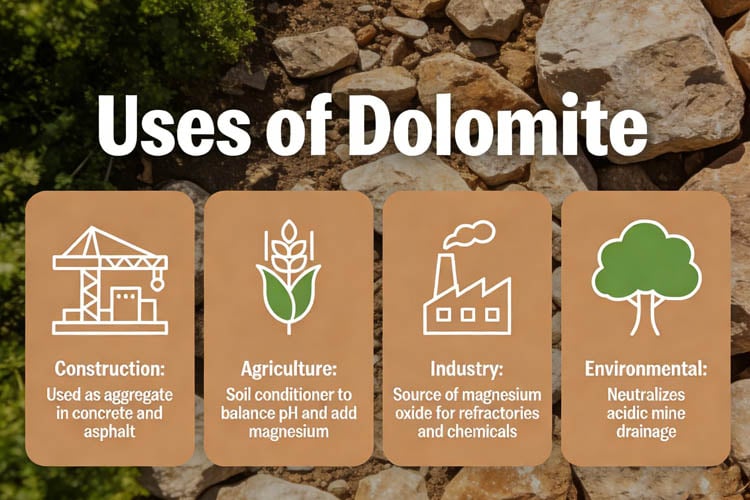
1. Construction and Building Materials
Dolomite serves as a fundamental aggregate in construction, providing superior characteristics compared to standard limestone. Its optimal hardness (3.5-4 on Mohs scale) and crystalline structure make it exceptionally durable for:
- Concrete production: Dolomite aggregates enhance compressive strength and reduce permeability
- Asphalt mixtures: Improves binding properties and resistance to rutting
- Road base materials: Offers excellent load-bearing capacity with minimal degradation
- Railroad ballast: Provides superior drainage and track stability
The construction sector consumes approximately 65% of global dolomite production, with specific technical requirements including:
- Minimum magnesium oxide (MgO) content: 18-20%
- Low iron oxide (Fe₂O₃) content: <0.5% for most applications
- Specific gravity: 2.8-2.9 g/cm³
- Los Angeles abrasion value: <25% for high-quality aggregates
2. Steel Manufacturing
In iron and steel production, dolomite functions as both a fluxing agent and refractory material. The mineral's dual role includes:
- Fluxing applications: Dolomite removes impurities (silica, alumina) by forming slag with lower melting points
- Refractory linings: Calcined dolomite (doloma) withstands temperatures exceeding 1700°C in basic oxygen furnaces and electric arc furnaces
- Slag conditioners: Magnesium oxide content modifies slag viscosity and chemical properties
Technical specifications for metallurgical-grade dolomite typically require:
- MgO content: 19-21%
- SiO₂ content: <2.5%
- Loss on ignition (LOI): 46-47%
- Low phosphorus and sulfur content
The steel industry's shift toward basic oxygen processes has increased dolomite consumption by approximately 40% over traditional open-hearth methods.
3. Agricultural Applications
Dolomite limestone serves as a vital soil amendment with multiple agricultural benefits:
- pH regulation: Neutralizes acidic soils more effectively than calcitic limestone due to slower dissolution rates
- Magnesium supplementation: Provides essential magnesium for chlorophyll synthesis and enzyme activation
- Calcium provision: Supports cell wall structure and membrane integrity in plants
- Micronutrient availability: Improves soil conditions for nutrient uptake
Agricultural specifications vary by crop requirements:
- Fineness: Minimum 90% passing through 100-mesh sieve
- Effective Calcium Carbonate Equivalent (ECCE): 90-105%
- Magnesium content: 10-13% for standard applications
- Neutralizing value: 95-108%
Recent research indicates dolomite application can increase crop yields by 15-25% in magnesium-deficient soils while reducing aluminum toxicity in highly acidic tropical soils.
4. Glass and Ceramics Manufacturing
The glass industry utilizes dolomite as a stabilizing agent and flux:
- Container glass production: Magnesium oxide improves chemical durability and resistance to thermal shock
- Float glass manufacturing: Dolomite reduces devitrification and enhances workability
- Fiberglass production: Provides essential magnesium for specific formulations
- Ceramic glazes: Acts as a flux in mid-range firing temperatures (1100-1250°C)
Stringent quality controls govern glass-grade dolomite:
- Fe₂O₃ content: <0.1% for clear glass, <0.3% for colored glass
- Consistent particle size distribution: 90% between 75-150 microns
- Low chromium and manganese oxides: <0.001% each
- Minimal organic contamination
The global glass industry consumes approximately 8 million tons of dolomite annually, with growing demand from specialty glass segments.
5. Environmental Remediation
Dolomite demonstrates remarkable effectiveness in environmental applications:
- Acid mine drainage treatment: Neutralizes acidic waters while precipitating heavy metals
- Flue gas desulfurization: Removes sulfur dioxide from industrial emissions
- Wastewater treatment: Adjusts pH and removes phosphates through precipitation
- Land reclamation: Rehabilitates disturbed soils and mining sites
Environmental applications benefit from dolomite's:
- High reactivity with acids
- Buffer capacity across a pH range of 6-8
- Low solubility products for metal carbonates
- Cost-effectiveness compared to alternatives
Recent developments include engineered dolomite nanoparticles for targeted contaminant removal with 30-50% greater efficiency than conventional materials.
6. Refractory Industry
Dead-burned dolomite (calcined at 1500-2000°C) creates highly stable refractory materials:
- Basic refractory bricks: For steel ladles, cement kilns, and non-ferrous metallurgy
- Gunning mixes: For repair and maintenance of refractory linings
- Monolithic refractories: Castables and plastics for complex furnace geometries
Refractory-grade dolomite must exhibit:
- High bulk density: >3.0 g/cm³ after calcination
- Low hydration tendency: <2% rehydration after 24 hours
- Specific crystal size: 50-200 microns for optimal sintering
- High purity: >97% CaMg(CO₃)₂
The global refractory dolomite market exceeds $2.5 billion annually, with specialized grades commanding premium prices.
7. Animal Feed Supplement
Dolomite provides essential minerals in animal nutrition:
- Calcium and magnesium source: Supports bone development, nerve function, and enzyme systems
- Ruminant nutrition: Magnesium prevents grass tetany in grazing livestock
- Poultry production: Strengthens eggshells and supports skeletal development
- Acid-neutralizing agent: In animal digestive systems
Feed-grade dolomite requires:
- Ultra-fine grinding: 95% passing 200-mesh sieve
- Heavy metal limits: Lead <10 ppm, arsenic <2 ppm, mercury <0.1 ppm
- Microbiological standards: <10,000 CFU/g total plate count
- Consistent mineral composition
Research indicates optimal dolomite supplementation improves feed conversion efficiency by 3-8% in various livestock species.
8. Chemical Manufacturing
Dolomite serves as a raw material for numerous chemical processes:
- Magnesium compounds: Production of magnesium oxide, hydroxide, and metal
- Calcium magnesium acetate: An environmentally friendly deicing agent
- Precipitated calcium carbonate: With controlled particle morphology
- Catalyst supports: In various chemical reactions
Chemical processing utilizes selective calcination and leaching to separate calcium and magnesium components. The Pidgeon process, while energy-intensive, remains important for magnesium metal production from dolomite.
9. Ornamental Stone and Dimension Stone
Dolomitic marble and decorative stones offer:
- Architectural cladding: With distinctive crystalline textures
- Monumental stone: Superior weathering resistance compared to pure calcite marble
- Interior finishes: Flooring, countertops, and decorative elements
- Landscaping materials: Retaining walls and decorative aggregates
Commercial dimension stone requires:
- Uniform color and texture
- Minimum block sizes: 2m × 1m × 1m for economical processing
- Compressive strength: >70 MPa
- Low porosity and water absorption: <1%
The dimension stone industry processes approximately 5 million tons of dolomite annually, with Italy, India, and Brazil leading production.
10. Novel and Emerging Applications
Recent technological developments have expanded dolomite applications:
- Biomedical materials: Drug delivery systems and bone graft substitutes
- Composite materials: Reinforcement in polymer matrices
- Carbon capture: Enhanced mineral carbonation processes
- Energy storage: Potential electrode materials in magnesium-ion batteries
- Water filtration: Advanced media for specific contaminant removal
Research indicates surface-modified dolomite nanoparticles demonstrate:
- 40% greater adsorption capacity for organic pollutants
- Controlled release profiles for agricultural nutrients
- Enhanced mechanical properties in composite materials
Market Dynamics and Future Outlook
The global dolomite market, valued at approximately $25 billion in 2023, continues evolving with several key trends:
- Sustainability drivers: Increasing demand for acid-neutralizing agents in environmental applications
- Technical specialization: Growing need for high-purity, consistently graded materials
- Regional production shifts: Asia-Pacific now dominates production with 65% market share
- Value-added products: Premium pricing for processed and engineered dolomite products
Future developments will likely focus on:
- Energy-efficient processing technologies
- Advanced material applications in nanotechnology
- Circular economy integration through byproduct utilization
- Digital quality control and traceability systems
Dolomite's remarkable versatility stems from its unique dual-cation structure, variable physical properties, and chemical reactivity. From foundational construction materials to sophisticated environmental and technological applications, this mineral continues to demonstrate expanding utility across traditional and emerging sectors. As industrial processes evolve toward greater efficiency and sustainability, dolomite's importance appears destined to increase rather than diminish, supported by ongoing research into novel applications and processing technologies. The future of dolomite utilization will be characterized by increased technical specialization, value-added processing, and strategic integration into circular economic models, ensuring this ancient mineral remains relevant in modern industrial ecosystems.
Understanding these diverse applications enables more strategic resource utilization, informed investment decisions, and innovative product development across the value chain. As global challenges related to construction, manufacturing, agriculture, and environmental protection intensify, dolomite stands positioned as a multifunctional solution mineral with untapped potential awaiting further technological exploitation.







 24/7 Online