To maximize profitability in remote regions, implementing a high-efficiency granite crushing line in Africa is the ultimate solution. Configuring a three-stage crushing circuit that combines a modular jaw crusher (Primary), a single-cylinder hydraulic cone crusher (Secondary), and a multi-cylinder hydraulic lamination cone crusher (Tertiary) driven by Variable Frequency Drives (VFDs) can reliably slash per-ton energy costs by 25% to 40%. By maintaining a consistent choke-fed condition above 300 mm and integrating pre-screening circuits, quarry operators can eliminate a 25% deadweight workload, upgrade to IE3/IE4 motor efficiency, and significantly optimize the total cost of ownership (TCO) under severe grid power deficits.
In modern mineral processing and aggregate production across Africa—including major mining hubs in Ghana, Guinea, Nigeria, and the DRC—granite stands out as one of the most lucrative yet energy-intensive materials due to its extreme hardness and highly abrasive nature. However, independent mining operations constantly face two severe operational bottlenecks: a total lack of public grid coverage (or severe grid voltage fluctuations of 30% to 40%), and a total reliance on diesel generator sets that drives the comprehensive cost of electricity up to 0.35 to 0.55 USD per kWh. Under traditional plant configurations, power consumption and frequent unscheduled downtime can easily swallow over 40% of a quarry's gross profit.
When operating under "no grid, low power, and expensive fuel" conditions, copy-pasting generic plant designs is a guaranteed recipe for failure. This technical brief details how to configure an ultra-efficient granite crushing production line that reliably slashes per-ton energy costs by 25% to 40%.
To achieve extreme energy savings, you must first identify exactly how precious diesel energy is wasted in conventional crushing circuits:
Given that granite features extreme hardness (Mohs hardness 6–7) and massive compressive strength (150–250 MPa), an energy-saving production line must strictly adhere to the engineering principles of "more crushing, less grinding; inter-particle lamination crushing; and dynamic variable frequency."
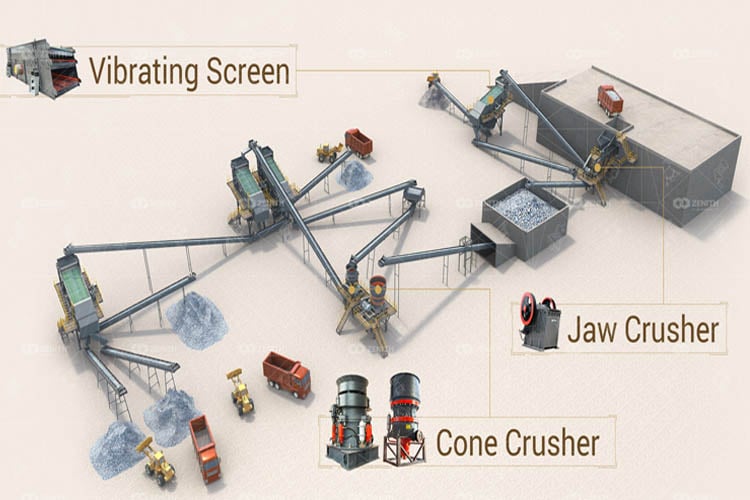
As the entry point of the entire circuit, primary crushing efficiency dictates downstream energy demand. It is highly recommended to select modular, non-welded structure jaw crushers (such as the ZENITH C6X Series Jaw Crusher):
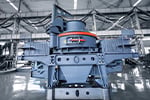
In power-deficit mining zones, it is strictly forbidden to use traditional spring cone crushers or low-efficiency impact crushers for processing medium-to-hard granite. Upgrading to advanced hydraulic cone crushers is mandatory:
Technical Expert Tip: The absolute gold standard for processing hard granite with the lowest comprehensive power consumption is pairing a large-cavity Single-Cylinder Hydraulic Cone Crusher (HST Series) for secondary crushing with a Multi-Cylinder Hydraulic Cone Crusher (HPT Series) for tertiary fine crushing.
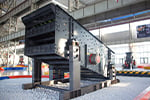
Traditional granite crushing plants tend to dump all run-of-mine material straight into the next crushing stage. The ultimate energy-saving trick is installing a heavy-duty Vibrating Grizzly Feeder fitted with a blind-plate section right before primary and secondary crushing. Any natural fines, clay, or already-qualified aggregates are 100% bypassed via a side chute, ensuring they never enter the crusher chambers. This simple process modification immediately eliminates 15% to 25% of the crusher's dead weight workload.
Because African remote mines rely on captive diesel generators, the micro-grid frequency is highly susceptible to instability. All high-power motors (such as main crusher drives, heavy conveyor belts, and main screens) must be equipped with VFDs:
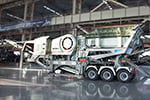
To capitalize on long-term infrastructure shifts—such as local grid expansions, fluctuating day/night fuel tariffs, or the future integration of mine-site hybrid solar/hydro power plants—operators should prioritize tracked or wheeled mobile stations or fixed plants configured with a Dual-Power Mode. If a localized power source becomes available, the plant can seamlessly switch from diesel generation to direct grid power within 30 seconds, instantly locking in long-term margins.
Based on data from a typical remote African quarry producing 500,000 tons of granite aggregate per year, with diesel priced at 1.2 USD/Liter (equating to a generator power cost of 0.42 USD/kWh), a 5-year Total Cost of Ownership (TCO) analysis reveals:
| Technical & Economic Metrics | Traditional Setup (Standard Jaw + Spring Cone Crusher) | Ultra-Efficient Setup (C6X Jaw + Hydraulic Lamination Cone + PLC VFD) | Energy Savings & ROI Payback |
|---|---|---|---|
| Comprehensive Power Draw per Ton | 4.2 – 5.5 kWh / Ton | 2.9 – 3.6 kWh / Ton | Reduces net electricity consumption by 30% - 35% |
| Useless Stone Powder/Waste Rate | 18% - 22% (Severe over-crushing) | 10% - 12% (High-ratio lamination) | Increases qualified product yield by 8% - 10% |
| Comprehensive Energy Cost per Ton | Approx. 2.05 USD / Ton | Approx. 1.34 USD / Ton | Direct fuel/power savings of 0.71 USD per ton |
| 5-Year Accumulated Fuel & Material Cash Savings | Baseline Circuit | Total savings on diesel and material waste: Approx. 1,775,000 USD | The entire premium equipment cost difference is fully recovered within 12 to 14 months |
Operating a mine in an environment devoid of public utility grids and plagued by high diesel prices means that choosing low-cost, low-efficiency crushing machinery is a slow financial suicide. Configuring a highly energy-efficient granite crushing line is far more complex than just slapping on a few frequency changers; it is a system-level process revolution encompassing heavy-duty dynamic machine profiles, strategic pre-screening layouts, maximum lamination crushing to prevent fines, and smart interconnected plant automation.
Investing in a high-configuration, low-energy production line driven by hardcore technology may carry a slightly higher initial capital expenditure (CAPEX) compared to generic alternatives. However, the sheer volume of cold, hard cash shaved off your fuel bills within the first year proves that this is the most secure, robust, and risk-resistant investment decision you can make for your African mining concession.
Do you want to receive a customized 3D plant layout design and generator-matching budget spreadsheet tailored to your specific African mining concession for free? Contact our on-site African engineering specialist team today!
A: Granite is an extremely hard rock with high silica content. While impact crushers are cheaper initially, processing granite with them causes rapid blowbar wear, leading to frequent shutdowns and high operational costs. A hydraulic cone crusher uses laminated crushing principles, which drastically reduces wear parts consumption and guarantees stable running.
A: To handle local grid shortages, ZENITH designs granite crushing lines with energy-efficient motors and optimized electrical control systems. We also provide customized configurations compatible with low-operating-cost industrial diesel generator sets, ensuring uninterrupted daily production.
A: Yes, ZENITH provides turnkey solutions across Africa. We have localized offices and experienced engineers in countries like Nigeria, Zambia, Kenya, and Tanzania who offer on-site topographic surveys, foundation drawing design, localized installation, and comprehensive operator training.


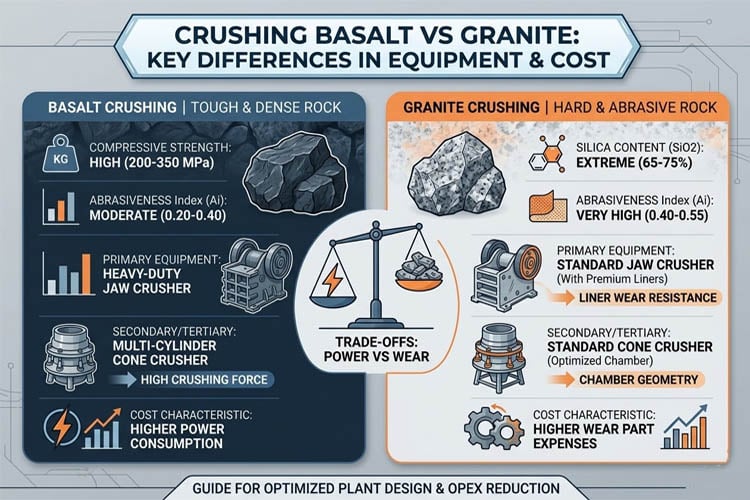
Compare Basalt vs. Granite crushing: Learn how silica content, hardness, and toughness affect equipment choice, wear costs, and ROI in aggregate production.
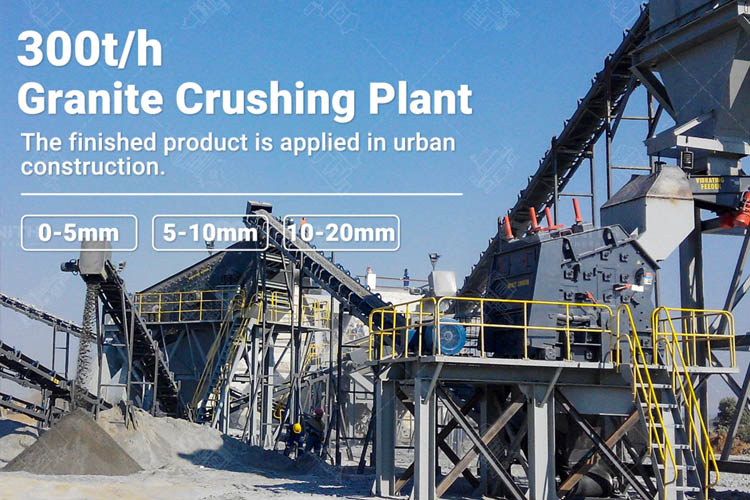
Due to the high quality of granite, the machine-made sand made from granite is very popular in the field of sand and gravel. And due to its high hardness, the choice of granite stone crushing machine should be careful.
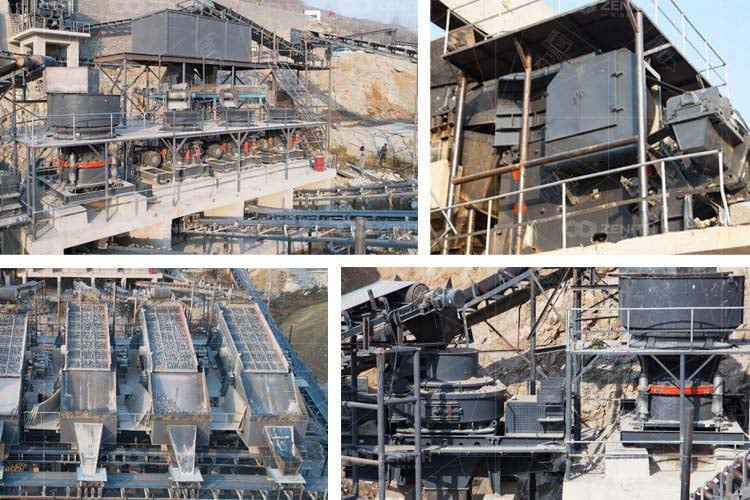
Stone crusher can be widely found in South Africa mining site, it is the basic machine for mineral processing line. Zenith will provide you with crushers of different styles and sizes at the best price according to your requirements.
Fill your requirements here, and we'll send the custmized solution and quotation to you by the reserved contact information.
Copyright ©2000-2026 SHANGHAI ZENITH MINERAL CO.,LTD.

 WhatsApp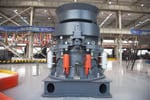

 24/7 Online