
 WhatsApp
Ball mills are the workhorses of mineral processing plants, responsible for grinding millions of tons of ore annually. Yet, one question consistently puzzles plant operators and metallurgists: At what point is ball mill efficiency maximized?
The efficiency of a ball mill is maximum when it operates within a critical speed range of 65% to 75% while maintaining a grinding media filling level of 35% to 45% of the mill's total volume. At this precise cross-section, the synchronized interaction of optimal velocity and charge volume achieves a perfect balance between impact shattering (cataracting) and abrasive grinding (cascading), maximizing throughput while minimizing energy dissipation.
This guide provides a comprehensive, data-driven analysis of ball mill efficiency optimization, covering critical speed, media motion, charge parameters, and real-world optimization results.
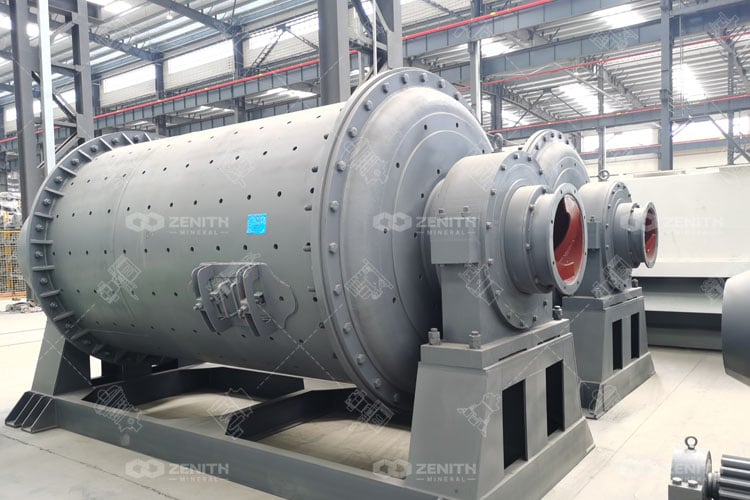
Understanding Critical Speed
What Is Critical Speed?
Critical speed is the theoretical rotational speed at which the grinding media begins to centrifuge against the mill's inner wall. At this point, gravity is exactly balanced by centrifugal force, and the balls cease to tumble or fall, rendering the grinding process ineffective.
The critical speed is expressed as a percentage of the theoretical critical speed. Most industrial ball mills operate between 60% and 80% of critical speed, with the most common range being 65% to 75%.
The Three States of Grinding Media Motion
The efficiency of a ball mill is determined entirely by which of three motion states the grinding media is in, all controlled by speed:
| Motion Type | Speed (% of Critical) | Grinding Action | Efficiency |
|---|---|---|---|
| Cascading | Below ~60% | Primarily abrasion (rubbing) | Low — slow, inefficient for coarse material |
| Cataracting (Optimal) | 65% – 75% | Powerful impact + abrasion | Maximum — ideal balance |
| Centrifuging | At/Above 100% | No grinding action | Very low — wastes energy |
1. Cataracting (The Optimal Zone): Between 65% and 75% of critical speed, the balls are carried further up the side of the mill before detaching and falling onto the material below. This "cataracting" motion generates a powerful combination of impact (for breaking coarse particles) and abrasion (for reducing fine particles). This is the zone where most ball mills achieve maximum throughput and efficiency.
2. Cascading (Low Speed): At low speeds (typically below 60% of critical speed), the balls gently tumble over one another. This creates grinding action primarily through abrasion. While effective for very fine grinding, the process is slow and lacks the high-impact force needed to break down larger particles efficiently.
3. Centrifuging (High Speed): As the speed approaches and exceeds critical speed, the grinding media becomes pinned to the mill liner. No tumbling or impact occurs, and grinding effectiveness drops to nearly zero. This state wastes enormous energy and causes excessive wear on the mill's lining.
Operational Parameters That Define Maximum Efficiency
Achieving maximum ball mill efficiency is not the result of any single variable. Instead, it emerges from the careful calibration of four interconnected operating parameters: grinding media fill level, material-to-ball ratio, grinding concentration (for wet mills), and the size distribution of the grinding media itself. Each factor must be optimized in relation to the others.
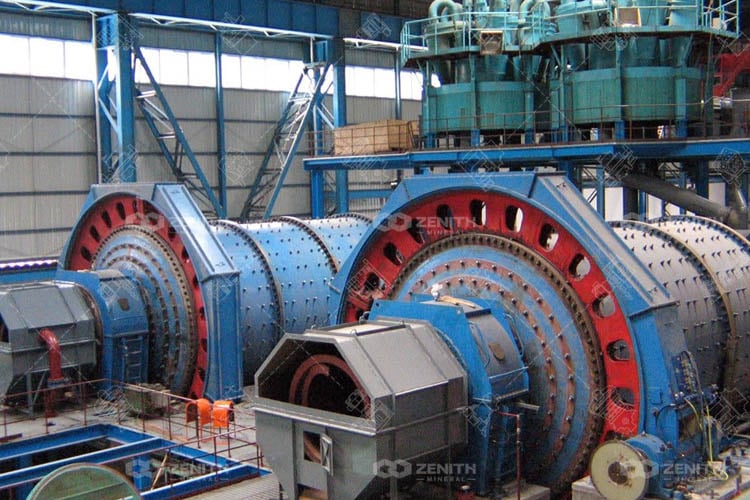
1. Grinding Media Fill Volume
The volume of the mill occupied by grinding balls is a primary determinant of grinding efficiency. This parameter, typically expressed as a percentage of the mill's total internal volume, has a clearly defined optimal operating zone: 35% to 45%.
- Optimal Fill (35% – 45%): This is the "sweet spot" for most industrial ball mills. Within this range, there are sufficient balls to create a dense, energetic grinding zone while still leaving enough void space for proper cataracting motion and efficient material flow. This balance maximizes the impact and abrasion forces necessary for effective grinding, leading to peak energy utilization and throughput.
- Underloading (below 35%): When the fill volume drops below 35%, there are too few balls to generate sufficient impacts per revolution. The grinding action becomes sparse, and a significant portion of the energy is wasted on rotating empty space. This condition reduces the mill's throughput and increases the specific energy consumption per ton of material ground.
- Overloading (above 45%): When the fill volume exceeds 45%, the available space within the mill for the balls to tumble freely becomes inadequate. The grinding media becomes tightly packed, restricting its motion and dampening the critical cataracting action that generates high-energy impacts. The weight of the excess charge can also overload the mill's drive system and lead to excessive liner wear.
Industrial practice has consistently validated the 35% to 45% range as the optimal starting point for most operations. While the precise optimum within this band may shift slightly depending on mill design, ball size, and the material being ground, this range provides a robust and reliable foundation for achieving maximum grinding efficiency. Research utilizing the discrete element method and response surface methodology has confirmed that peak energy utilization is achieved within this zone.
2. Material-to-Ball Ratio
The ratio of material being ground to the mass of grinding media is another critical efficiency parameter. This is sometimes referred to as the powder filling factor. If the mill contains too much material relative to the balls, the grinding media is effectively cushioned, absorbing energy that should be used to fracture particles. The material also fills the spaces between balls, reducing the impact energy available for breakage. Conversely, if too little material is present, the grinding media impacts against itself and the mill liners, accelerating wear without performing meaningful work, and energy is wasted on generating heat and noise rather than particle breakage.
The optimal material-to-ball ratio is specific to the ore type, grind size target, and mill operating conditions. However, research provides valuable reference points. One study utilizing an industrially validated simulation model identified an optimal material-to-ball ratio of 0.4 for a specific grinding task. This ratio, combined with a media filling ratio of twenty-five percent and a grinding concentration of seventy-five percent solids, produced the highest energy efficiency for the tested material. This ratio means that for every one hundred kilograms of steel balls, forty kilograms of ore feed should be present in the mill for the most efficient energy transfer.
3. Grinding Concentration (Pulp Density)
For wet grinding operations, which represent the majority of industrial ball mill applications, the density of the slurry within the mill has a profound impact on efficiency. The grinding concentration, typically expressed as the percentage of solids by weight in the slurry, must be maintained within a specific optimal range: 60% to 75% solids.
- Optimal Concentration (60% – 75% solids): Within this range, the slurry provides sufficient particle density to promote efficient energy transfer from the grinding media to the ore, while maintaining adequate fluidity for proper tumbling action and material flow. This balance ensures effective particle capture and fracture without impeding mill discharge, resulting in peak grinding efficiency.
- Underloading (below 60% solids): When the slurry is too dilute, the grinding media is insufficiently cushioned, leading to direct metal-to-metal contact between balls. This accelerates media and liner wear significantly. Furthermore, a dilute slurry allows particles to settle and stratify, reducing the probability of effective particle capture and fracture.
- Overloading (above 75% solids): When the slurry is too thick, the viscosity of the pulp increases to the point where it acts as a viscous fluid that dams the grinding media. The balls cannot move freely through the dense slurry, reducing both impact energy and the tumbling action essential for grinding. This high viscosity also reduces the ability of the mill to discharge the ground product, leading to over-grinding and the inefficient retention of already-fine material.
The optimal grinding concentration typically lies between 60% and 75% solids by weight, with the exact value depending on particle density and mineralogy. Research using response surface methodology has identified optimal grinding concentrations within this range for various materials. For example, one study found that 75% solids maximized energy efficiency for the tested material. These findings confirm that while the precise optimum is application-specific, the 60% to 75% range provides a robust and reliable starting point for most wet grinding operations.
4. Grinding Media Size Distribution
The size distribution of the grinding balls within the mill is arguably the most influential operational parameter after rotational speed. A charge containing a single, uniform ball size is rarely optimal for any industrial grinding application. Instead, a graduated charge—a carefully designed mixture of large, medium, and small balls—is essential for maximizing efficiency.
The logic behind this is straightforward. Large balls (typically sixty to one hundred millimeters in diameter) generate the high-impact forces necessary to fracture coarse feed particles. However, they have a limited surface area and are ineffective at grinding fine particles. Small balls (generally twenty-five to forty millimeters) have a vast surface area and are highly efficient at fine grinding, but they lack the mass needed to break coarse particles. Without the presence of medium balls to bridge the gap, the mill's performance is compromised for either the coarse or the fine end of the particle size range.
The optimal media size distribution is directly linked to the particle size distribution of the feed material. For a given feed size, the ball size should be roughly twenty times the particle diameter for optimal breakage kinetics. This general rule suggests that if the feed material contains a mixture of coarse and fine particles, the ball charge must also contain a mixture of different ball sizes to address each particle size class effectively.
Industrial trials have clearly demonstrated the benefits of optimizing media size distribution. One study on a 3.2 meter by 4.5 meter ball mill found that adjusting the ball charge to a composition of thirty percent one hundred-millimeter balls, twenty percent eighty-millimeter balls, twenty percent sixty-millimeter balls, and thirty percent forty-millimeter balls dramatically improved performance. The optimized charge increased mill throughput by nearly nine percent, increased the production of the targeted fine particle fraction by nearly nine percent, and reduced the energy consumption per ton of material processed by more than seven percent.
Another investigation identified a different optimal distribution for a laboratory scale mill, specifically a mixture of sixty-millimeter, fifty-millimeter, and thirty-millimeter balls in proportions of twenty-five, thirty-five, and forty percent, respectively. These findings collectively emphasize that while the exact distribution is application-specific, a graduated charge is always superior to a uniform charge for maximizing grinding efficiency.
Practical Guidelines for Achieving Maximum Efficiency
- If your focus is maximum throughput: Operate near the higher end of the optimal speed range (around 75% of critical speed) and maintain a media fill level in the 35%–45% range. Ensure the ball size distribution correctly matches your feed material.
- If your focus is achieving the finest grind: Operate at the lower end of the optimal speed range (around 65% of critical speed) to favor abrasion over impact. Use smaller grinding media to increase surface area contact, and be prepared for longer grinding retention times.
- If your focus is minimizing operational cost: Operate at a slightly lower speed (around 65–70% critical speed) to significantly reduce liner and media wear. Monitor media and material charge levels to ensure no energy is wasted.
How to Maximize Ball Mill Efficiency: A System-Level Approach
The efficiency of a ball mill is not maximized at a single, fixed speed. Rather, maximum efficiency is achieved within the cataracting zone — typically between 65% and 75% of critical speed — where grinding media creates the ideal balance of impact and abrasion. Combined with a 35% to 45% media fill level and an optimized slurry density, these parameters form the foundation of high-performance grinding.
True optimization requires balancing speed, media size distribution, fill volume, and material characteristics to match your specific operational goals: throughput, product fineness, or energy efficiency. By systematically adjusting these interconnected variables and leveraging the optimization models validated by recent research, plant operators can achieve substantial improvements — including 8-9% increases in throughput and 7% reductions in energy consumption.
At ZENITH, we engineer grinding solutions that help you reach and sustain peak mill efficiency. From optimal media size selection to full circuit optimization, our team works alongside yours to reduce energy consumption, increase throughput, and lower total cost of ownership. Contact us today to learn how we can help you maximize your ball mill performance.
Frequently Asked Questions
Q: When Is the Efficiency of a Ball Mill Maximum?
A: The efficiency of a ball mill is maximum at a rotational speed of 65% to 75% of its critical speed, combined with a volumetric grinding media filling level of 35% to 45% of the mill's total volume, and a pulp density maintained between 60% and 75% solids by weight.
Q: What happens if my ball mill runs faster than critical speed?
A: Grinding effectively stops. The media centrifuges against the mill wall, causing no tumbling or impact, wasting energy, and accelerating liner wear.
Q: How much improvement can I expect from optimization?
A: Industrial trials show optimized ball size distribution can increase mill throughput by 8.59%, improve fines production by 8.97%, and reduce energy consumption per ton by 7.19%.
Q: How often should I review my ball mill settings?
A: Regularly — especially when feed material characteristics change. Systematic monitoring of particle size distribution, power draw, and media consumption is essential for maintaining peak efficiency.


 24/7 Online