How to Identify Gold Ore in the Field: Types, Indicators, and Tests
To successfully find and identify gold in the wild, you must first understand its geological source. Gold primarily occurs in two major ore types:
- Lode Gold (Primary Deposits): Native gold trapped inside hard bedrock, most commonly within hydrothermal quartz veins or sulfide-rich rocks.
- Placer Gold (Secondary Deposits): Loose, water-worn gold nuggets, flakes, and dust eroded by nature into riverbeds, streams, and alluvial gravels.
How to accurately identify gold in the field: Do not rely on how shiny a rock is. Real gold is exceptionally dense (19.3 g/cm³), highly malleable (it dents smoothly under a steel pin rather than shattering), and leaves a bright yellow streak on an unglazed ceramic tile. In contrast, "fool's gold" (Pyrite) is brittle and leaves a greenish-black streak.
Gold, one of the most sought-after precious metals on Earth, forms in highly specific geological environments. Understanding how these unique deposits develop is the key to knowing exactly where to look. This professional guide provides a comprehensive breakdown of the major gold ore types, their physical field indicators, and the fool-proof, low-cost testing methods you need to confidently distinguish true precious metals from worthless look-alikes.
Classification of Gold Ore Types
Gold deposits are classified based on their geological formation processes, host rocks, and occurrence forms, which directly determine their appearance, distribution, and extraction methods. The following are the most common and economically significant gold ore types, each with distinct field characteristics:
1. Lode Gold Ore (Primary Gold Deposits)
Lode gold ore, also known as vein gold ore or primary gold deposit, represents the original source of most of the world's gold. These deposits are formed through complex hydrothermal processes deep within the Earth’s crust, typically in tectonically active zones such as subduction zones, continental collision belts, or major fault systems.
It occurs as native gold particles, flakes, or veins embedded in host rocks, formed when hot, gold-bearing fluids migrate through fractures and cavities in rocks and precipitate gold as the fluids cool and pressure decreases.
1.1 Key Subtypes of Lode Gold Ore
- Orogenic Gold Deposits: The most widespread lode gold type, formed during mountain-building processes. They are typically associated with metamorphic rocks such as schist, gneiss, and quartzite, and often occur in quartz veins that cut through these host rocks. These veins are usually white or milky quartz, sometimes stained with iron oxides (rusty red or brown), and gold is often found along the vein walls or as inclusions within the quartz.
- Epithermal Gold Deposits: Formed in shallow crustal environments (less than 1,500 meters deep) associated with volcanic activity. Host rocks include volcanic rocks (basalt, rhyolite, andesite) and sedimentary rocks near volcanic zones. Gold in these deposits is often fine-grained, sometimes mixed with silver, and may be associated with minerals like pyrite, chalcopyrite, and sphalerite. The host rocks often show signs of hydrothermal alteration, such as silicification (hardening and whitening), argillization (clay formation), and propylitization (greenish alteration).
- Carlin-Type Gold Deposits: A unique type of sediment-hosted gold deposit, primarily found in carbonate rocks (limestone, dolomite). Gold in these deposits is extremely fine-grained (microscopic), often invisible to the naked eye, and is adsorbed onto pyrite or organic matter within the host rock. The host rocks typically show decalcification (loss of calcium carbonate) and jasperoidization (formation of fine-grained silica), and may have arsenic anomalies, which are a key indicator for this deposit type.
1.2 Field Appearance of Lode Gold Ore
Lode gold ore is rarely found as large nuggets; instead, gold appears as small, bright yellow flakes, grains, or thin veins within host rocks. The host rocks are often fractured, and quartz veins are a primary indicator—these veins can range from a few millimeters to several meters in width, and may be single or interconnected. Iron oxide staining (rusty red, orange, or brown) on the vein walls or surrounding rock is common, as sulfide minerals associated with gold oxidize over time. In some cases, gold may be mixed with other sulfide minerals, giving the rock a dark, metallic luster in addition to the bright yellow of gold.
2. Placer Gold Ore (Secondary Gold Deposits)
Placer gold ore is a secondary deposit formed by the erosion and transportation of primary lode gold deposits by natural forces such as water, wind, and glaciers. As the host rock of lode gold weathers and breaks down, gold particles are released and transported by rivers and streams.
Due to gold's high density (19.3 g/cm³), it settles out of the water current in areas with reduced flow, forming placer deposits—this is the type of gold most commonly associated with "gold panning" and prospecting.
2.1 Key Subtypes of Placer Gold Ore
- Alluvial Gold Deposits: The most common placer type, found in riverbeds, stream channels, and floodplains. Gold accumulates in gravel bars, behind boulders, in the crevices of bedrock, and in the "slack water" areas on the inside bends of rivers (where water flow is slower). Alluvial gold particles are rounded and smooth due to constant tumbling and abrasion by water and sediment, ranging in size from microscopic grains to large nuggets (the largest gold nugget ever found, the "Welcome Stranger," was an alluvial nugget weighing over 70 kilograms).
- Eluvial Gold Deposits: Formed when gold particles are eroded from lode deposits but remain in the weathered rock and soil near the original source, without being transported far by water. These deposits are found on hillsides and slopes above lode gold veins, and gold particles are less rounded than alluvial gold, often retaining some angularity from the original host rock.
- Glacial Gold Deposits: Formed by glacial erosion and deposition, found in areas covered by ancient glaciers. Glaciers grind up lode gold deposits and transport gold particles along with glacial till (mixture of rock, sand, and gravel). These deposits are often widespread, and gold may be found in glacial moraines, outwash plains, and eskers, with particles ranging in size from fine sand to large nuggets.
2.2 Field Appearance of Placer Gold Ore
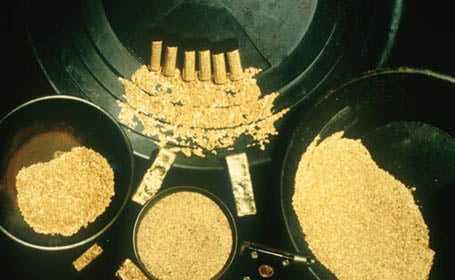
Placer gold is easily recognizable in the field due to its distinctive bright yellow color and high density. In riverbeds, it is often found mixed with black sand (a mixture of heavy minerals like magnetite, hematite, and ilmenite), which has a similar density to gold and settles in the same areas. Gold particles are typically smooth and rounded, with a metallic luster that does not tarnish or rust. Fine-grained placer gold may appear as a yellow "dust" in the crevices of bedrock or mixed with sand, while larger nuggets are rare but stand out due to their size and color. In eluvial deposits, gold particles are more angular and may be mixed with weathered rock fragments and soil.
3. Other Minor Gold Ore Types
In addition to lode and placer gold, there are several minor gold ore types that are less common but still economically significant in some regions:
- Skarn Gold Deposits: Formed by the reaction between hydrothermal fluids and carbonate rocks (limestone, dolomite) near igneous intrusions. Gold is often associated with minerals like garnet, pyroxene, and sulfides, and host rocks show distinct skarn alteration (formation of calcium-rich silicate minerals).
- Intrusion-Related Gold Deposits: Associated with large igneous intrusions (granite, diorite), formed when gold-bearing fluids are released from the cooling magma. Gold is often found in the contact zone between the intrusion and surrounding host rocks, or in veins within the intrusion itself.
- Black Shale-Hosted Gold Deposits: Formed in organic-rich black shale rocks, where gold is adsorbed onto organic matter or sulfide minerals. Gold in these deposits is often fine-grained and may be associated with other precious metals like silver and platinum.
Field Identification of Gold and Gold-Bearing Rocks
Identifying gold in the field requires a combination of observing visual characteristics, using simple field tests, and understanding the geological context of the area. While laboratory analysis (such as fire assay or X-ray fluorescence) is the only way to confirm the presence and grade of gold, the following methods can help prospectors and geologists identify potential gold-bearing rocks and gold particles in the wild, with a focus on practical, low-cost techniques that can be performed on-site.
1. Visual Identification: Key Characteristics to Look For
Visual inspection is the first and most basic step in field identification. Gold has unique physical properties that distinguish it from other minerals, and gold-bearing rocks often show telltale signs of hydrothermal activity or weathering.
1.1 Identifying Native Gold Particles
Native gold (the purest form of gold found in nature) has several distinctive physical properties that make it easy to identify in the field:
- Color: Gold has a bright, distinctive yellow color that does not fade or tarnish over time. Unlike other yellow minerals (such as pyrite, also known as "fool's gold"), gold's yellow is warm and intense, with a metallic luster that reflects light strongly. If gold is alloyed with silver (which is common), it may appear paler, with a yellow-white or silvery-yellow hue, but it will still retain its metallic luster.
- Shape and Texture: In lode deposits, gold appears as angular flakes, grains, or thin veins within host rocks, often with a rough, crystalline texture. In placer deposits, gold particles are smooth and rounded, with a waxy or polished surface from constant abrasion. Large nuggets may have irregular shapes, with small indentations or "pockmarks" from weathering.
- Luster: Gold has a metallic luster, meaning it reflects light like a metal (e.g., a coin or a metal spoon). This distinguishes it from non-metallic yellow minerals, which have a dull or glassy luster.
- Streak: The streak of a mineral (the color of its powder when rubbed on an unglazed ceramic surface) is a reliable identification tool. Gold has a golden yellow streak, which is unique among minerals. In contrast, pyrite has a greenish-black streak, and chalcopyrite (another yellow sulfide mineral) has a black streak—this is one of the easiest ways to distinguish gold from "fool's gold" in the field.
1.2 Identifying Gold-Bearing Rocks
Most gold is not visible to the naked eye, especially in fine-grained deposits like Carlin-type gold, so identifying gold-bearing rocks requires looking for indirect indicators of gold mineralization:
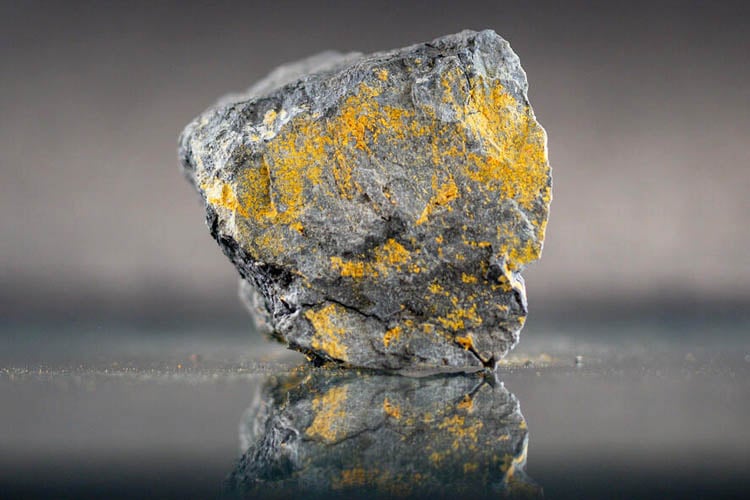
Isolated gold ore specimen from Carlin-type deposit
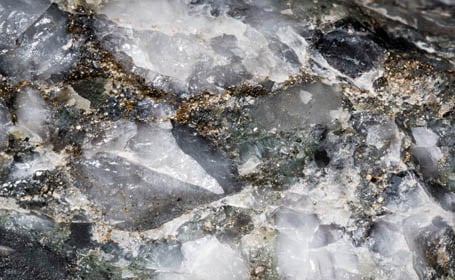
- Quartz Veins: Quartz veins are the most common host for lode gold, especially orogenic gold deposits. Look for white, milky, or gray quartz veins cutting through metamorphic or volcanic rocks—these veins may be narrow (a few millimeters) or wide (several meters), and may be associated with iron oxide staining (rusty red or brown) on the vein walls or surrounding rock. The presence of quartz veins in areas with a history of gold mineralization is a strong indicator of potential gold.
- Hydrothermal Alteration: Gold-bearing hydrothermal fluids alter the host rock as they migrate through it, leaving behind distinct mineralogical changes. Common signs of alteration include: silicification (whitening and hardening of the rock, due to the addition of silica), argillization (formation of clay minerals, giving the rock a soft, earthy texture and a gray or brown color), propylitization (greenish alteration, due to the formation of minerals like chlorite and epidote), and carbonatization (formation of carbonate minerals like calcite). These alteration zones often surround gold veins and can extend several meters into the host rock.
- Associated Minerals: Gold is often found in association with sulfide minerals, such as pyrite (fool's gold), chalcopyrite (brass-yellow), sphalerite (brown or black), and galena (gray). The presence of these minerals, especially in large quantities or in association with quartz veins, is a strong indicator of potential gold mineralization. Additionally, minerals like scheelite (white or yellow) and tourmaline (black or green) may be associated with gold in some deposits.
- Iron Oxide Staining: As sulfide minerals associated with gold oxidize over time, they produce iron oxides (hematite, goethite), which stain the rock a rusty red, orange, or brown color. This staining is common in weathered lode gold deposits and can be seen on the surface of rocks, in soil, and in stream beds (as red or brown sediment). In placer deposits, iron oxide staining may be mixed with black sand and gold particles.
- Geological Context: Understanding the regional geology of an area is critical for identifying gold-bearing rocks. Gold deposits are often found in areas with: mountain-building processes (orogenic gold), volcanic activity (epithermal gold), carbonate rocks (Carlin-type gold), or ancient river systems (placer gold). Look for maps of the area to identify these geological features, and focus exploration on fault zones, shear zones, and contact zones between different rock types—these are areas where gold-bearing fluids are most likely to migrate and precipitate gold.
2. Simple Field Tests for Gold Identification
While visual identification is useful, simple field tests can help confirm whether a mineral is gold or a look-alike (such as pyrite or chalcopyrite). These tests are low-cost, easy to perform in the field, and require only basic tools that most prospectors and geologists carry with them.
2.1 The Streak Test (Most Reliable Field Test)
The streak test is the most reliable and easiest test to distinguish gold from other yellow minerals. To perform the test:
- Obtain an unglazed ceramic tile (the back of a bathroom tile or a streak plate, which is available at most rock and mineral supply stores) and a small sample of the mineral you suspect is gold.
- Rub the mineral firmly against the unglazed surface of the tile to leave a powder streak.
- Examine the color of the streak: gold will leave a bright golden yellow streak, while pyrite will leave a greenish-black streak, chalcopyrite will leave a black streak, and brass will leave a gray streak.
Note: If the mineral is large enough, you can also scrape a small amount of powder off with a knife and examine the powder color—this is a good alternative if you do not have a streak plate.
2.2 The Hardness Test
Gold has a low hardness (2.5–3 on the Mohs scale of mineral hardness), which means it is soft and can be scratched by common household items. This is another easy way to distinguish gold from harder look-alike minerals (pyrite has a hardness of 6–6.5, chalcopyrite has a hardness of 3.5–4).
To perform the hardness test:
- Use a knife, a copper penny (hardness 3.5), or a nail (hardness 4–4.5) to scratch the mineral sample.
- If the mineral is easily scratched by the knife or penny, it may be gold (or another soft mineral like silver). If the mineral cannot be scratched by the knife or nail, it is likely pyrite or another hard mineral.
- Conversely, gold can scratch softer minerals like talc (hardness 1) or gypsum (hardness 2), but cannot scratch harder minerals like quartz (hardness 7).
Caution: Be careful when scratching the mineral sample to avoid damaging valuable gold nuggets or specimens.
2.3 The Density Test (Sink-Float Test)
Gold has an extremely high density (19.3 g/cm³), much higher than most other minerals (pyrite has a density of 5.0 g/cm³, quartz has a density of 2.65 g/cm³). This makes the sink-float test a useful way to identify gold in placer deposits, where gold is mixed with sand and gravel.
To perform the density test in the field:
- Fill a small container (like a vial or a gold pan) with water, and add a small amount of the mineral sample (or sand/gravel from a stream bed).
- Shake the container gently to mix the sample with the water, then let it settle for a few seconds.
- Gold will settle to the bottom of the container very quickly due to its high density, while lighter minerals like quartz and sand will settle more slowly, and floating materials (like organic debris) will remain on the surface.
- For a more precise test, you can use a liquid with a known density (such as mercury, but mercury is toxic and not recommended for field use) or a homemade density solution (e.g., a mixture of water and salt), but the simple water sink-float test is sufficient for most field applications.
2.4 The Malleability Test
Gold is highly malleable, meaning it can be hammered or pressed into thin sheets without breaking. This is a unique property of gold and other precious metals (like silver and copper) and can be used to distinguish gold from brittle look-alike minerals.
To perform the malleability test:
- Take a small sample of the mineral and place it on a hard surface (like a rock or a metal plate).
- Gently tap the sample with a hammer or a rock hammer. If the sample is gold, it will flatten into a thin sheet without breaking or crumbling. If the sample is pyrite or another brittle mineral, it will break into small pieces or crumble when tapped.
Note: This test is only suitable for larger gold particles or nuggets—fine-grained gold cannot be tested this way without being lost.
2.5 Testing for Tarnish
Gold is highly resistant to tarnish and corrosion, even when exposed to air and water for long periods. In contrast, most other yellow minerals (like pyrite and chalcopyrite) will tarnish over time, developing a dull, gray, or greenish coating.
To test for tarnish: Examine the surface of the mineral sample for any signs of discoloration or dullness. If the sample is bright yellow with no tarnish, it may be gold. If the sample has a dull coating or shows signs of rust (iron oxide), it is likely a sulfide mineral or another non-gold mineral. You can also rub the sample with a clean cloth—if the yellow color is restored and no black or greenish residue is left on the cloth, it is more likely to be gold.
3. Advanced Field Techniques for Gold Exploration
For more serious prospecting and geological exploration, advanced field techniques can help identify gold-bearing areas and confirm the presence of gold, even in fine-grained or invisible gold deposits. These techniques require specialized tools but are highly effective for targeting potential gold deposits:
- Gold Panning: A classic technique for finding placer gold in riverbeds and streams. To pan for gold: fill a gold pan with sand and gravel from the stream bed, add water, and swirl the pan gently to wash away the lighter sand and gravel. Gold, being denser, will remain at the bottom of the pan, often mixed with black sand. This technique is not only a way to find gold but also to identify areas with high concentrations of placer gold.
- Metal Detecting: Metal detectors are a valuable tool for finding both placer gold and lode gold in the field. Modern metal detectors can distinguish between gold and other metals (like iron and copper) and can detect gold particles even at depth. They are especially useful for finding buried gold nuggets in placer deposits or gold veins in outcrops.
- Soil and Rock Sampling: Collecting samples of soil, rock, or stream sediment and sending them to a laboratory for analysis is the most reliable way to confirm the presence and grade of gold. For lode gold deposits, collect rock samples from quartz veins or altered host rocks; for placer deposits, collect sediment samples from stream beds (focusing on areas with black sand). Laboratory tests such as fire assay, atomic absorption spectroscopy (AAS), or X-ray fluorescence (XRF) can accurately measure the gold content of the samples.
- Geochemical Surveys: Geochemical surveys involve collecting soil, rock, or water samples from a large area and analyzing them for trace elements associated with gold (such as arsenic, antimony, mercury, and silver). These elements are often present in gold-bearing hydrothermal fluids and can serve as "pathfinder elements" for gold deposits, even if gold itself is not visible in the field.
Common Mistakes to Avoid in Field Identification of Gold
Even experienced prospectors and geologists can make mistakes when identifying gold in the field, especially when dealing with look-alike minerals or fine-grained deposits. The following are common mistakes to avoid:
- Mistaking Pyrite for Gold: Pyrite (fool's gold) is the most common mineral mistaken for gold, due to its bright yellow color and metallic luster. Always perform the streak test to distinguish pyrite from gold—pyrite has a greenish-black streak, while gold has a golden yellow streak. Additionally, pyrite is harder than gold and is brittle, while gold is soft and malleable.
- Ignoring the Geological Context: Gold deposits do not form randomly—they are associated with specific geological settings (e.g., volcanic zones, fault zones, carbonate rocks). Ignoring the regional geology can lead to wasted time and effort exploring areas with no potential for gold.
- Overlooking Fine-Grained Gold: Most gold is not visible to the naked eye, especially in Carlin-type or epithermal deposits. Do not assume a rock has no gold just because you cannot see it—collect samples for laboratory analysis to confirm.
- Neglecting Associated Minerals and Alteration: The presence of quartz veins, sulfide minerals, and hydrothermal alteration are strong indicators of gold mineralization, even if gold is not visible. Always look for these indirect indicators when exploring for gold.
- Using Unreliable Tests: Avoid relying on tests like the "acid test" (which involves applying acid to the mineral to see if it reacts) for gold identification—gold is resistant to acid, but so are many other minerals (like quartz), and the test can be dangerous if not performed properly. Stick to reliable tests like the streak test, hardness test, and density test.
Identifying gold ore in the field requires a combination of geological knowledge, careful observation, and practical testing. By understanding the different types of gold ore (lode and placer) and their distinct field characteristics, and by mastering simple, reliable identification techniques (such as the streak test, hardness test, and density test), prospectors, geologists, and mining enthusiasts can increase their chances of finding gold and evaluating potential gold deposits. Remember that visual identification and field tests are only preliminary—laboratory analysis is always required to confirm the presence and grade of gold.
If you are planning a gold exploration project or need assistance with ore sampling, laboratory analysis, or gold processing equipment selection, contact our team of experienced mineral processing engineers for professional guidance and support.
Common Questions About Identifying Gold Ore in the Field
Q1: What are the two main types of gold ore?
A: The two main types are Lode Gold (primary deposits) where gold is trapped inside hard bedrock, commonly within hydrothermal quartz veins or sulfide-rich rocks, and Placer Gold (secondary deposits) which are loose, water-worn gold nuggets, flakes, and dust found in riverbeds, streams, and alluvial gravels.
Q2: How can I distinguish real gold from pyrite (fool's gold) in the field?
A: You can distinguish real gold from pyrite using several tests: the streak test (gold leaves a golden-yellow streak, pyrite leaves a greenish-black streak), the hardness test (gold is soft and can be scratched with a knife, pyrite is hard and resists scratching), and the malleability test (gold flattens when struck, pyrite shatters). Real gold is also much denser (19.3 g/cm³) than pyrite.
Q3: What is the most reliable field test for identifying gold?
A: The streak test is the most reliable and easiest field test. Rub the mineral on an unglazed ceramic tile. Gold will leave a bright golden-yellow streak, while pyrite leaves a greenish-black streak, and chalcopyrite leaves a black streak.
Q4: What are the visual indicators of lode gold ore?
A: Lode gold ore appears as small, bright yellow flakes, grains, or thin veins within host rocks. Key visual indicators include white or milky quartz veins, iron oxide staining (rusty red, orange, or brown) on the vein walls or surrounding rock, and the presence of associated sulfide minerals like pyrite and chalcopyrite.
Q5: What does placer gold look like in the field?
A: Placer gold appears as small, rounded, and smooth bright yellow flakes or nuggets, often mixed with black sand (heavy minerals like magnetite). It has a metallic luster that does not tarnish or rust. Fine placer gold may appear as a yellow "dust" in bedrock crevices, while larger nuggets are rare but distinctive.
Q6: What is the density of gold and how can it help with identification?
A: Gold has an extremely high density of 19.3 g/cm³. This high density is useful for identification through the sink-float test, where gold will settle to the bottom of a container very quickly when mixed with water, much faster than lighter minerals like quartz or sand.



 WhatsApp




 24/7 Online