
 WhatsApp
Limestone is a naturally occurring sedimentary rock composed primarily of calcium carbonate (CaCO₃). As one of the most abundant and versatile minerals on Earth, limestone serves as a fundamental raw material across construction, manufacturing, environmental protection, agriculture, and chemical industries. After crushing, grinding, or high-temperature calcination, limestone can be transformed into aggregates, powder, quicklime, and hydrated lime for diverse commercial uses. Below are the 10 most important uses of limestone with detailed industrial explanations.
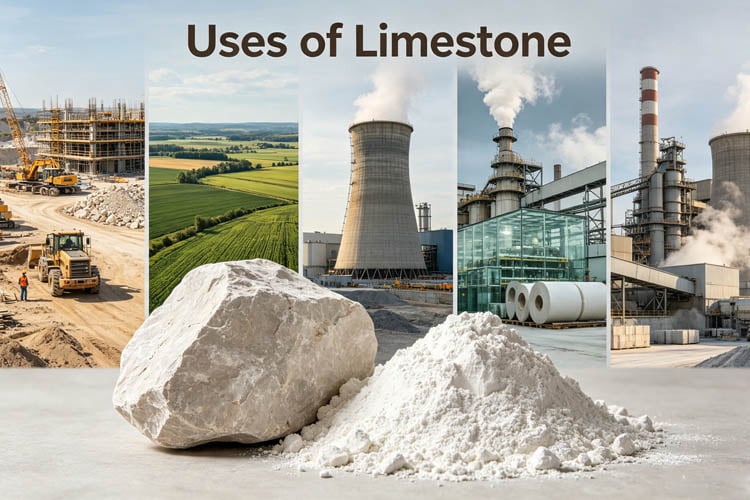
1. Cement Manufacturing (Largest Industrial Use)
The single largest consumer of limestone globally is the cement industry. Limestone is the foundational ingredient in Portland cement, the vital binding agent used in almost all modern concrete.
To create cement, crushed limestone is mixed with clay or shale and fed into a massive rotary kiln heated to approximately 1,450°C. At these extreme temperatures, the materials undergo a chemical reaction (calcination), fusing together to form hard, marble-sized lumps called clinker. This clinker is then cooled and finely ground with a small amount of gypsum to produce the final cement powder. Without limestone, modern urban infrastructure simply could not exist.
Why Limestone is Crucial
- Calcium oxide (lime) is the primary chemical component required for cement production
- It reacts with silica and alumina from clay to form the hydraulic compounds (calcium silicates) that give cement its strength
- Limestone provides the necessary calcium to create the chemical reactions essential for cement hardening
Approximately 1.6 tons of raw limestone are needed to produce one ton of cement, highlighting the critical role limestone plays in global infrastructure development.
2. Construction Aggregates and Road Base
Limestone is the most widely used stone in construction. Its durability, workability, and aesthetic appeal make it a preferred material for building foundations, walls, and architectural features.
Crushed Stone for Bases and Sub-bases
The majority of crushed limestone is used as aggregate for the construction of roads, highways, railways, and airport runways. It forms a stable, load-bearing base and sub-base layer beneath asphalt and concrete surfaces, providing excellent drainage and preventing frost heave.
Building Stone and Cladding
Limestone has been used as a building stone for millennia. Its natural beauty and range of colors (from white and cream to gray and buff) make it a popular choice for both interior and exterior cladding. Famous structures like the Great Pyramid of Giza, the Parthenon, and the Lincoln Memorial in Washington D.C. are constructed from limestone.
Mortar and Plaster
Finely ground limestone is mixed with clay, sand, and water to produce mortar for binding bricks and stones. Lime-based plasters are also used for coating interior walls, providing a breathable, durable finish.
Why It Excels
- High compressive strength
- Excellent workability (can be cut and shaped)
- Aesthetic versatility
- Good thermal and acoustic insulation properties
3. Concrete Production
Limestone is the primary source of aggregate in concrete, which is the most consumed material in the world after water. Over 70% of concrete's volume consists of aggregates, with limestone being the most common choice.
Role as a Coarse and Fine Aggregate
Limestone provides the structural "skeleton" of concrete, giving it its compressive strength. The angular, crushed shape of limestone particles provides excellent interlocking properties, enhancing the concrete's load-bearing capacity.
Advantages of Limestone Aggregate
- High strength and durability
- Low water absorption
- Good workability for concrete mixes
- Cost-effective and widely available
Filler in Cement
Limestone is also used as a filler material in Portland cement. When finely ground, it improves the workability and finish of concrete while reducing the overall carbon footprint of the cement production process.
4. Flux in Iron and Steel Smelting
Limestone is an absolute necessity in the metallurgical industry, particularly in the production of iron and steel. Inside a blast furnace, iron ore is melted to extract pure iron, but the raw ore contains high levels of silica and other impurities that must be removed.
Limestone is added to the furnace as a fluxing agent. Under intense heat, the limestone melts and chemically reacts with the silica to form a liquid waste product known as slag. Because this slag is lighter than the molten iron, it floats to the surface where it is easily skimmed off, leaving behind the purified iron required to manufacture high-strength steel.
5. Chemical Manufacturing
Limestone is a fundamental raw material in the chemical industry, serving as a source of lime (calcium oxide) and carbon dioxide.
Production of Quicklime (CaO)
Heating limestone in a lime kiln at temperatures above 900°C drives off carbon dioxide, producing quicklime. This is one of the most widely used chemicals in the world.
Production of Slaked Lime (Ca(OH)₂)
Adding water to quicklime produces slaked lime (calcium hydroxide), which is used in a variety of chemical processes.
Applications in Chemical Manufacturing
- Alkali production: Used in the manufacture of sodium carbonate (soda ash) and other alkalis
- Calcium carbide: An intermediate compound used to produce acetylene gas for welding and cutting
- PVC production: Used as a stabilizer in the production of polyvinyl chloride
6. Agriculture: Soil Amendment and Animal Feed
Limestone plays a vital role in sustainable agriculture by improving soil health and supporting animal nutrition.
Soil Amendment (Liming)
Agricultural lime (aglime), typically ground limestone, is applied to soil to:
- Neutralize soil acidity (raise pH)
- Improve nutrient availability (e.g., phosphorus, potassium)
- Enhance microbial activity
- Increase crop yields
The calcium in limestone also improves soil structure, promoting better root development and water infiltration.
Animal Feed Additive
Limestone is commonly used as a dietary supplement in animal feed, particularly for poultry and livestock. It provides:
- Calcium for strong bones and eggshell formation
- Essential minerals for metabolic functions
Calcium supplements for humans are also derived from limestone, demonstrating its importance in the food chain.
7. Water and Wastewater Treatment
Municipal water treatment plants utilize limestone to ensure drinking water is safe and non-corrosive. If municipal water is too acidic, it can strip lead and copper from aging city pipes, creating severe public health hazards.
Filtering water through limestone beds naturally elevates the pH, stabilizing the water and protecting the plumbing infrastructure. In industrial wastewater treatment, lime is also used to precipitate dissolved heavy metals out of toxic runoff so they can be safely filtered out before the water is released into the environment.
Key Applications
- pH adjustment: Limestone neutralizes acidic water, making it safe for consumption and industrial use
- Coagulation and flocculation: Aids in the removal of suspended particles and impurities
- Heavy metal removal: Helps precipitate heavy metals, allowing them to be filtered out
- Sewage treatment: Used in the treatment of municipal and industrial wastewater
Benefits in Water Treatment
- Cost-effective and readily available
- Safe for use in drinking water treatment
- Effective in reducing corrosion in pipes
8. Flue Gas Desulfurization
As global environmental regulations tighten, limestone has become a critical tool for air pollution control. Coal-burning power plants and heavy industrial incinerators release sulfur dioxide—a toxic gas that causes acid rain.
To combat this, facilities use a process called Flue Gas Desulfurization (FGD). Ultra-fine limestone powder (mixed with water to form a slurry) is sprayed directly into the exhaust chimneys (flues). The calcium carbonate reacts instantly with the sulfur dioxide, neutralizing the gas and converting it into solid synthetic gypsum, which can then be safely disposed of or sold to drywall manufacturers.
9. Glass and Ceramic Manufacturing
Limestone serves as a critical flux and stabilizer in glass and ceramic production. During high-temperature melting, limestone decomposes into calcium oxide, which reduces the melting point of silica raw materials, accelerates material melting, and saves furnace energy consumption.
In float glass, container glass, and fiberglass production, limestone effectively stabilizes glass structure, improves transparency, and prevents product deformation and cracking. In ceramic tile and pottery manufacturing, limestone adjusts blank formula, enhances sintering density, and improves finished product hardness and glossiness.
10. Manufacturing and Consumer Products
Limestone's versatility extends to a wide range of everyday products and industrial applications.
Paints and Coatings
Finely ground limestone (calcium carbonate) is used as a pigment and extender in paints, primers, and coatings. It provides:
- Whiteness and opacity
- Improved rheological properties
- Cost-effective volume extension
Plastics and Polymers
Limestone is used as a filler in various plastics, including PVC, polyethylene, and polypropylene. It enhances:
- Mechanical properties (stiffness and impact resistance)
- Thermal properties (heat resistance)
- Cost-efficiency by reducing polymer content
Adhesives and Sealants
Calcium carbonate is a common filler in:
- Construction adhesives
- Caulking compounds and sealants
- Hot-melt adhesives
Rubber and Tires
Limestone is used as a reinforcing filler in rubber products, including tires, to improve durability and reduce cost.
Papermaking
Limestone is used as a coating pigment and filler in paper production to improve whiteness, opacity, and printability.
Toothpaste and Cosmetics
The fine, abrasive nature of calcium carbonate makes it an ideal ingredient in toothpaste for cleaning teeth. It is also used in cosmetics as a bulking agent and absorbent.
Dietary Supplements
Calcium carbonate derived from limestone is the most common form of calcium supplement, used to support bone health and prevent osteoporosis.
Limestone is far more than a common construction stone. Its unique chemical stability, alkalinity, and processability enable it to support cement production, infrastructure construction, metallurgical smelting, environmental governance, agricultural improvement, and industrial manufacturing. The 10 core applications cover almost all basic industries, proving limestone’s irreplaceable strategic position in modern industrial and social development. Reasonable crushing, grinding, and calcination processing can maximize the economic value of limestone resources for mining and processing enterprises.





 24/7 Online