
 WhatsApp
In the world of gold processing, gravity concentration is the oldest and often the most economically attractive method of recovery. It leverages the simplest of principles—the significant difference in specific gravity between gold (SG ≈ 19.3) and typical gangue minerals (SG ≈ 2.7)—to achieve an efficient separation. While cyanidation and flotation dominate bulk gold recovery, gravity concentration circuits are indispensable for capturing coarse and fine liberated gold early in the process. Doing so prevents its over-grinding, improves overall plant recovery, and reduces downstream processing costs.
However, the market offers a diverse array of gravity concentration technologies, from jigs and spirals to advanced centrifugal concentrators. Selecting the right device is not a matter of finding the "best" technology, but of matching the most suitable technology to the specific characteristics of the ore and the operational objectives of the plant. We will explore the different types of gravity concentrators available, the principles behind gravity concentration, and key considerations for selecting the most suitable equipment.
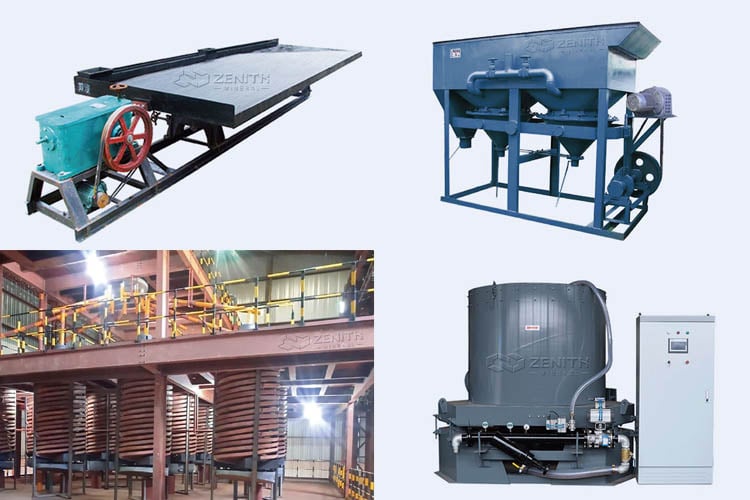
What is Gravity Concentration?
Gravity concentration is the process of separating minerals based on differences in their specific gravity. Since gold has a high specific gravity (approximately 19.3), it is much heavier than most other minerals present in the ore. Gravity concentrators use this difference to isolate gold from the rest of the material.
Gold gravity concentrators are particularly effective for processing free gold or gold particles that are liberated during the milling or grinding process. They are often used in combination with other methods like flotation or cyanidation to increase recovery rates.
Key Types of Gravity Concentrators for Gold
Gravity concentrators for gold come in various types, each offering unique advantages. Some of the most common gravity concentrators include:
- 1. Shaking Tables
- 2. Jig Concentrators
- 3. Spiral Concentrators
- 4. Centrifugal Concentrators
Let’s explore each of these in more detail.
1. Shaking Tables
Shaking Tables are flowing-film concentrators, typically used for cleaning rather than primary recovery.
- Principle: A gently sloped, riffled deck is subjected to a differential shaking motion while a film of water flows across it. This stratifies particles by both size and density, creating distinct bands of minerals.
- Best For: Final upgrading of gravity concentrates from jigs or centrifugal bowls to produce a high-grade, direct-smeltable product.
- Pros: Produces exceptionally high-grade concentrates; provides visual control over separation.
- Cons: Very low capacity; large footprint per ton processed; requires a skilled operator.
2. Jig Concentrators
Jig concentrators are gravity-based separation devices that use a pulsating water column to separate gold particles from lighter minerals. The jigging action moves heavier gold particles downward and lighter particles upward.
Advantages:
- Simple to use and cost-effective for small-scale operations.
- Can handle a wide range of material sizes.
- Does not require a large amount of water or power to operate.
- Good for processing ores with high variability.
Disadvantages:
- Lower recovery rates for very fine gold compared to other methods.
- Slower throughput compared to centrifugal concentrators.
- Requires skilled operators for efficient performance.
3. Spirals
Spirals are high-capacity, low-cost devices for pre-concentration.
- Principle: Slurry flows down a helical trough. As it does, centrifugal force pushes denser particles toward the inner part of the spiral, where they are removed through ports.
- Best For: High-tonnage, low-cost pre-concentration of liberated gold-bearing minerals (like sulfides) or in mineral sands operations.
- Pros: No moving parts; low operational cost; high throughput.
- Cons: Lower recovery efficiency for fine, free gold compared to centrifugal units; requires significant vertical height.
4. Centrifugal Concentrators
Centrifugal concentrators portable devices used to capture fine gold. These concentrators rely on centrifugal force to separate gold particles from lighter materials.
Advantages:
- Affordable and easy to operate.
- Portable and suitable for small-scale or artisanal miners.
- Effective for fine gold recovery in small operations.
- Minimal water and power requirements.
Disadvantages:
- Limited capacity and throughput.
- May not be as efficient for coarse gold.
- Requires more frequent cleaning and maintenance.
Factors to Consider When Choosing a Gold Gravity Concentrator
Selecting the right gravity concentrator for gold recovery involves careful consideration of several factors. Here’s a breakdown of the most important aspects:
1. Ore Type and Particle Size Distribution
- Fine Gold Recovery: If the gold in the ore is particularly fine, you may need a concentrator with high efficiency for fine gold.
- Coarse Gold Recovery: For ores containing larger particles of gold, gravity concentrators like jigs or shaking tables are often more effective.
- Ore Composition: The nature of the ore (whether it contains other heavy minerals like platinum or other gold-bearing minerals) can impact the selection of a concentrator.
2. Throughput and Scalability
- Throughput: If you're operating on a large scale, you’ll need a concentrator capable of handling a high volume of material. Centrifugal concentrators or large-scale shaking tables may be suitable for high throughput operations.
- Scalability: Consider whether the concentrator can scale as your operation grows.
3. Recovery Efficiency
Recovery efficiency is a critical factor in determining the profitability of your gold mining operation. Concentrators are typically better for recovering a higher percentage of gold, especially fine gold. Shaking tables and jigs, while effective, may not achieve the same level of recovery efficiency.
4. Cost of Operation and Maintenance
Gravity concentrators come with varying costs for both initial investment and ongoing operation. Some concentrators, like shaking tables and spiral concentrators, require less power and have lower operating costs. Others, may have higher initial costs but offer superior performance and higher recovery rates.
5. Water and Power Requirements
Gravity concentrators have different water and power requirements. For operations in regions where water or power availability is limited, it may be advantageous to choose a concentrator that uses minimal resources, such as a centrifugal concentrator or spiral concentrator.
6. Ease of Operation and Maintenance
- Ease of Operation: Consider how easy the concentrator is to operate, especially if your team lacks specialized training.
- Maintenance Requirements: Some concentrators require more frequent maintenance due to the high speeds and complex mechanisms. Simple concentrators like jigs or shaking tables may require less upkeep.
Advanced Considerations & Best Practices
1. The Concept of "Gravity Circuit" vs. a Single Unit
Rarely is one device optimal for all gold sizes. A well-designed circuit often includes:
- Primary Rougher: A high-capacity device (jig or continuous centrifuge) to catch >80% of GRG.
- Scavenger: A secondary unit (another centrifuge or table) to treat the rougher tails.
- Cleaner: A shaking table to upgrade the combined rougher/scavenger concentrate to +95% purity for smelting.
2. Feed Preparation is Paramount
Gravity concentrators demand consistent, well-classified feed.
- Screen Out Oversize: Remove +2mm material that can disrupt beds or block waterways.
- Deslime Ultra-Fines: Sub-10µm slimes coat gold and increase viscosity, harming recovery. Consider a pre-desliming cyclone.
- Ensure Proper Feed Density: Maintain a consistent, optimal slurry percent solids (usually 25-55% depending on the device).
3. Monitoring, Control, and Optimization
- Install Mass Flow and Density Meters on the feed line for consistent operation.
- Routine Sampling & Performance Checks: Regularly sample feed, tailings, and concentrate to calculate recovery and adjust operating parameters (G-force, fluidization water, stroke length, pulse rate).
- Wear Inspection: Schedule regular inspections of critical wear parts to prevent sudden failure and performance drops.
Choosing the right gold gravity concentrator depends on several factors, including the nature of the gold ore, recovery efficiency, throughput requirements, and budget constraints. For high-efficiency recovery of fine gold, centrifugal concentrators are typically the best choice. However, for smaller operations or those processing coarse gold, simpler equipment like jigs, shaking tables, or spiral concentrators may suffice.


 24/7 Online