Basalt & River Stone Crusher Plant in Tropical Southeast Asia
The infrastructure boom across Southeast Asia—driven by massive public transit expansions, regional highway networks, and urban industrial zones—has generated an insatiable demand for high-grade construction aggregates. However, quarry operators in tropical rainforest climates face a dual engineering challenge: processing exceptionally tough, highly abrasive raw materials like basalt and river pebbles under extreme environmental conditions marked by relentless heat, torrential monsoon seasons, and high humidity.
To maintain maximum uptime and a profitable return on investment (ROI), production lines cannot rely on generic configurations. They must be engineered for both geological resilience and climate adaptation.
1. The Challenges of Tropical High-Hardness Aggregate Production
Designing a high-yield crushing plant in a tropical environment requires solving distinct mechanical and environmental issues:
High Material Hardness and Extreme Abrasiveness
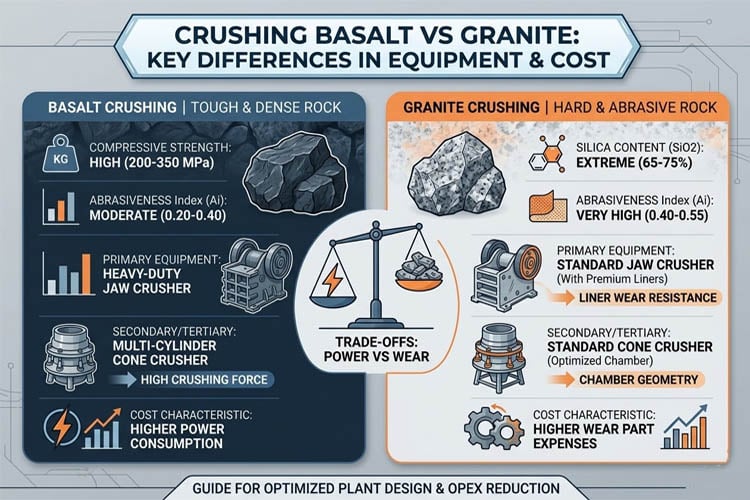
- The Geological Profile: Basalt (volcanic) and river pebbles (typically composed of quartz, granite, and dense basalt) often reach 6 to 8 on the Mohs hardness scale.
- The Impact: These materials possess high compressive strength and severe abrasiveness due to high silica content. Utilizing incorrect crushing technology, such as relying on impact crushers for secondary stages, results in catastrophic wear-part degradation, leading to frequent shutdowns and soaring operational expenses (OPEX).
Monsoon Moisture and High Humidity
- The Climate Profile: Tropical rainforest climates feature extended monsoon seasons with heavy daily downpours.
- The Impact: River pebbles extracted directly from riverbeds or basalt quarries heavily contaminated with tropical clay run wet and sticky. This material easily clogs traditional feed hoppers, binds screening meshes, and causes material accumulation in chutes, severely choking the plant's throughput.
High Ambient Temperatures
- The Environmental Profile: Sustained temperatures exceeding 40°C accelerate thermal stress on heavy machinery.
- The Impact: Intense heat thins hydraulic and lubrication oils, degrading the vital oil film protecting high-speed bearings. Without advanced thermal management, machines face high risks of sensor trips or catastrophic mechanical seizure.
Ebook Highlight: Analysis of the Southeast Asian Crushing and Screening Industry
Gain deep insights into investment costs, local mineral characteristics, and high-performance equipment selection for the SE Asia market.
- ✅ Regional market analysis & customer pain points
- ✅ Mobile plant & modular line solutions
- ✅ Real project cases across Southeast Asia
Download Ebook
2. How to Crush Basalt & River Stone in Tropical Climates
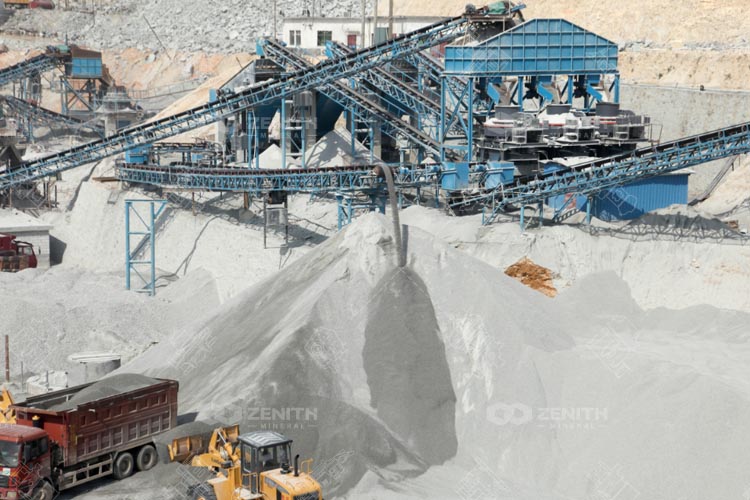
To process abrasive river stones and basalt into premium, cubical aggregates (meeting strict international standards like ASTM C33), a synchronized, multi-stage processing circuit is mandatory.
- Raw Material Feed
- Vibrating Feeder / Grizzly
- Coarse Crushing—Primary Jaw Crusher
- Medium Crushing—Cone Crusher
- Fine Sand Making & Shaping
- Precision Separation & Closed-Circuit Recirculation
- Premium Finished Aggregates (0-5-10-20-40mm)
Stage 1: Coarse Crushing (The Heavy-Duty Foundation)
- Equipment: Heavy-Duty Jaw Crusher.
- Configuration Logic: Large basalt blocks or oversized river boulders require a high reduction ratio at the entry point. The primary jaw crusher features a deep, "V"-shaped crushing chamber and high-manganese jaw plates, providing massive crushing force.
- Tropical Adaptation: To combat wet, clay-heavy feed during the monsoon, the primary stage must utilize a vibrating grizzly feeder with adjustable gap bars to scalp out fine soil and mud before it enters the crushing chamber, preventing compaction and clogging.
Stage 2: Medium/Fine Crushing (The Core Laminating Stage)
- Equipment: HST Single-cylinder Hydraulic Cone Crusher or HPT Multi-cylinder Hydraulic Cone Crusher.
- Configuration Logic: Impact crushers are strictly excluded from this stage due to the extreme wear costs of high-silica materials. Cone crushers utilize "inter-particle laminating crushing" technology. By compressing rock layers against rock layers rather than striking them directly, the machine dramatically extends the lifespan of manganese liners, optimizes energy consumption per ton (kWh/t), and ensures a consistent particle shape.
Stage 3: Fine Sand Making & Shaping (The Premium Finish)
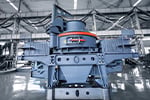
- Equipment: Vertical Shaft Impact (VSI) Sand Making Machine.
- Configuration Logic: High-spec concrete for modern infrastructure requires a low flakiness and elongation index. The VSI crusher uses a "rock-on-rock" high-velocity mechanism to polish the aggregates into a perfect cubical shape. Furthermore, as natural river sand regulations tighten across Southeast Asia, the VSI serves as the primary engine for high-grade manufactured sand (M-Sand) production.
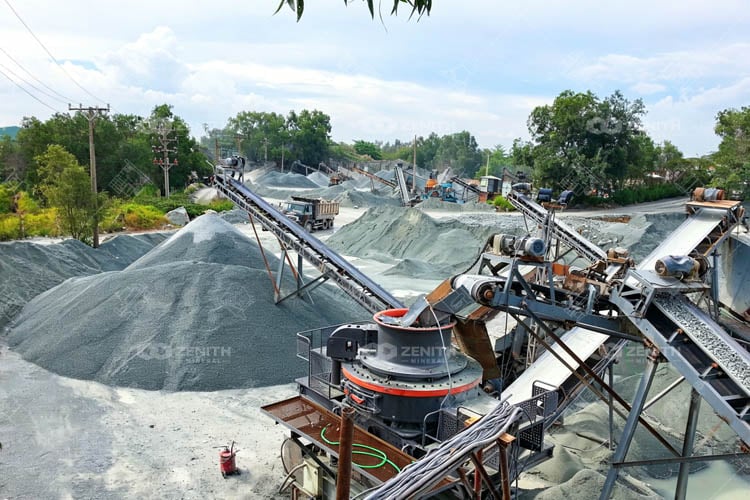
Stage 4: Precision Separation & Closed-Circuit Recirculation
- Equipment: High-Frequency Circular Vibrating Screens paired with Sand Washing Systems.
- Configuration Logic: Multi-deck screens segregate the output into commercial fractions (0–5mm, 5–10mm, 10–20mm, 20–40mm).
- The Closed Loop: Any oversized material that fails to meet grading specifications is automatically diverted via a return conveyor circuit back into the Stage 2 Cone Crusher for secondary reduction. To ensure clean product delivery during wet seasons, integrated wheel or bucket sand washers strip away micro-clays, yielding high-purity aggregates that bond perfectly with cementitious mixes.
3. Climate-Resilient Engineering Features
To keep production continuous through the highest heat and humidity index, a generic factory setup will fail. The physical plant layout must incorporate specialized thermal, structural, and mechanical defenses engineered specifically for tropical realities.
I. Dual-Loop Intelligent Thermal Management (Combating Extreme Heat)
When ambient temperatures breach 40°C, internal mechanical friction can push bearing temperatures past critical thresholds. Traditional cooling systems quickly become overwhelmed.
- The Technology: ZENITH integrates automated, dual-loop oil-to-air cooling radiators. High-precision thermal sensors continuously monitor the lubrication oil entering and exiting the cone crusher's eccentric shaft.
- The Mechanism: If the oil temperature rises by even 2°C above the optimal running zone, the system automatically activates auxiliary cooling fans and adjusts the flow rate. By maintaining a stable viscosity index, the machine guarantees that a high-strength oil film constantly protects the heavy-duty bearings, preventing catastrophic metal-on-metal seizure during peak midday sun.
II. Anti-Blinding Screen Technology (Combating Monsoon Rains)
During the tropical wet season, river pebbles are coated in slick mud, and blasted basalt contains sticky clay. When mixed with torrential rain, this material forms a paste that quickly blinds (plugs) standard steel wire screen meshes, grinding the separation process to a halt.
- The Technology: The configuration replaces rigid steel meshes with high-elasticity Polyurethane (PU) screen panels paired with specialized high-pressure washing spray bars.
- The Mechanism: Polyurethane possesses natural hydrophobic properties and flexibility. As the screen vibrates at high frequencies, the PU material flexes, naturally ejecting trapped near-size particles. Simultaneously, strategically angled water spray bars blast the screen surface, washing away micro-clays and turning sticky material into a cleanly separated, high-purity commercial aggregate.
III. Containerized, Dust-Proof PLC Climate Control
High humidity combined with fine rock dust is a lethal combination for electrical components. Moisture creates conductive paths on circuit boards, leading to short circuits, premature aging of switchgear, and frequent, unexplained PLC safety trips.
- The Technology: Moving away from standard on-board control panels, the entire electrical heart of the production line is housed in an isolated, heavy-duty containerized PLC control cabin.
- The Mechanism: These cabins are fully sealed, dust-proofed, and equipped with industrial-grade, redundant air conditioning units. By maintaining a constant internal temperature of 24°C and low humidity, the sensitive electronic brains of the plant—including frequency inverters and automated monitoring systems—are fully insulated from the harsh tropical climate outside, ensuring uninterrupted data flow and zero weather-related electrical downtime.
IV. Aerodynamic Plant Layout and Modular Ventilation
Spreading heat away from the machinery is just as important as cooling the machinery itself. Standard, tightly packed plant layouts create "heat pockets" where stagnant, hot air recirculates around the motors.
- The Technology: The production line utilizes an extended modular layout with open-frame structural steel supports.
- The Mechanism: By expanding the physical distance between the primary jaw crusher and the secondary cone crusher, and raising the structures off the ground, the design maximizes natural cross-ventilation. This aerodynamic configuration allows tropical winds to naturally carry away dissipated heat, lowering the ambient temperature around the main motors by 3°C to 5°C without consuming additional electrical power.
4. The ZENITH Solution: Engineered for Ultimate Durability
Overcoming the harsh realities of tropical aggregate production requires a machinery partner who understands both geology and environment. ZENITH’s material processing production lines are engineered from the ground up for maximum climate resilience.
By strategically configuring primary Jaw Crushers, high-efficiency Hydraulic Cone Crushers, and rock-on-rock VSI Shapers, ZENITH delivers plants that minimize wear-part replacements and reduce overall power consumption. Our modular and stationary production lines feature optimized ventilation profiles and heavy-duty alloy components built specifically to transform abrasive basalt and river pebbles into top-tier commercial aggregate—ensuring high uptime, low maintenance costs, and a rock-solid ROI through every season.



 WhatsApp

 24/7 Online