
 WhatsApp
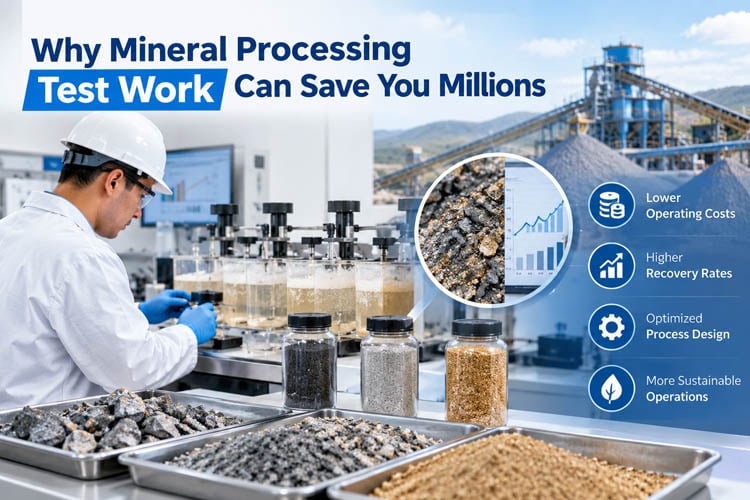
Mineral processing test work is the systematic laboratory and pilot-scale testing of an ore body to determine how it will behave during crushing, grinding, and beneficiation. It is the essential bridge between geological resource estimation and actual plant construction.
Why is it necessary? Because every ore body is unique. You cannot accurately size equipment, select the correct flowsheet, or predict recovery rates based on assumptions or data from a nearby mine.
The consequences of skipping it are severe: a single miscalculation can trigger a multimillion-dollar post-commissioning retrofit, cause regulatory shutdowns, and destroy project ROI through significantly lower-than-expected recovery rates.
Conversely, the advantages of investing in test work are massive. For a cost of just 0.5% to 2% of total CAPEX, comprehensive testing maximizes recovery rates, optimizes reagent consumption, ensures precise equipment sizing, and ultimately de-risks the project for investors.
This article breaks down the exact science of test work, how it is conducted, and why it is the cheapest insurance policy your mining project will ever buy.
Part I: What Is Mineral Processing Test Work?
Every ore body is unique. Even within the same mine, the mineralogy, hardness, and chemical composition can change drastically from one zone to another. Test work bridges the gap between a geological resource (rock in the ground) and a profitable operation (recovered metal).
The process typically involves three key stages:
1. Sample Collection and Characterization
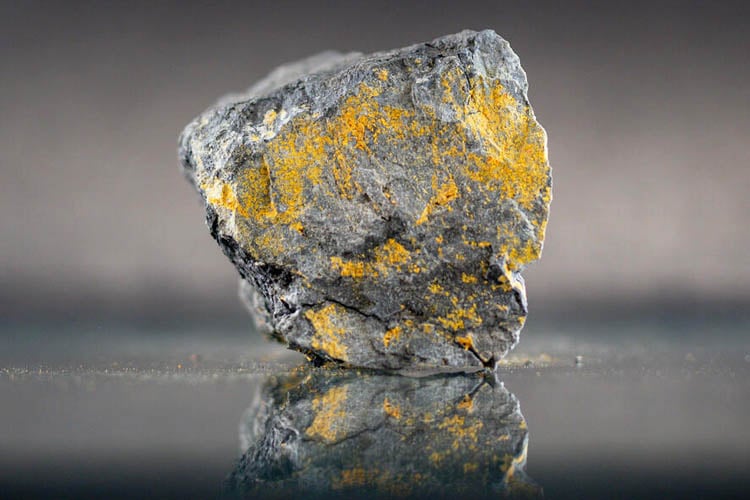
Representative samples are extracted from drill cores or bulk excavations. These samples are analyzed to understand the ore’s physical and chemical properties (hardness, mineralogy, liberation size, and deleterious elements).
2. Bench-Scale Testing
Small-scale laboratory tests are conducted to determine the best way to extract the valuable minerals.
- Comminution Testing: Determines how much energy is required to crush and grind the rock.
- Beneficiation Testing: Evaluates flotation, gravity, magnetic separation, or leaching methods to select the optimal process route.
- Locked-Cycle Tests: Simulates a continuous industrial circuit in the lab to predict real-world recovery rates.
3. Pilot Plant Testing
For large or complex projects, a small-scale continuous plant (processing 1–5 tons per day) is built to validate the flowsheet. This allows engineers to confirm reagent dosages, equipment sizing, and water management before spending hundreds of millions on full-scale construction.
Part II: Why Is Test Work Necessary?
You cannot design a processing plant based on assumptions. Test work is necessary for three fundamental reasons:
1. To Prove Economic Viability (Feasibility)
Investors and banks will not fund a mining project based on a guess. A Bankable Feasibility Study (BFS) requires hard data—specifically, verified recovery rates and reagent consumption—to prove the project will make money.
2. To Select the Correct Flowsheet
You cannot use a one-size-fits-all approach. A copper sulfide ore requires flotation, while a copper oxide ore requires leaching. If you build a flotation plant for an oxide ore, you will lose millions. Test work tells you exactly which beneficiation technology your specific ore requires.
3. To Size Equipment Accurately
If you undersize a SAG mill or a crusher, your entire plant will be bottlenecked, and you will never reach design capacity. If you oversize it, you waste precious CAPEX. Comminution tests (like the Bond Work Index) provide the mathematical data needed to size equipment perfectly.
Part III: The Consequences of Skipping Test Work
Skipping or under-budgeting for test work to "save time" is a false economy. Here are the severe consequences:
1. Catastrophic Equipment Retrofit
When a plant is built without testing, problems emerge during commissioning. The flotation cells might not achieve the required grade, or the thickener might overflow. Retrofitting a processing plant after it is built is incredibly expensive and can take 12 to 24 months, causing severe financial distress.
2. Overstated Recovery and Lost Revenue
If feasibility studies assume a 90% gold recovery without locked-cycle tests, but the actual plant achieves only 65%, the financial model collapses. On a 5,000 tpd gold plant, a 25% drop in recovery can mean losing $50 million to $100 million in revenue over the life of the mine.
3. Environmental and Permitting Failures
Certain ores generate acid mine drainage or contain toxic elements like arsenic. Without proper environmental test work, you may discover too late that your tailings management plan is inadequate, leading to regulatory shutdowns, massive fines, and project delays.
4. Uncontrolled Operating Costs
Without test work, you are guessing your reagent consumption (e.g., cyanide, xanthate, lime). A 30% increase in reagent dosage due to unexpected ore chemistry can destroy your profit margin.
Part IV: The Advantages of Investing in Test Work
Investing in comprehensive test work yields a massive Return on Investment (ROI).
1. Lower Capital Expenditure (CAPEX)
By accurately sizing equipment, you avoid the cost of oversizing. By selecting the right flowsheet from the start, you avoid expensive post-commissioning redesigns.
2. Maximized Recovery Rates
Test work optimizes reagent dosages, grind sizes, and circuit configurations. A 2% or 3% increase in recovery, achieved through optimization, translates to tens of millions of dollars in added revenue over a 10-year mine life.
3. Reduced Operational Expenditure (OPEX)
Testing determines the lowest possible energy and reagent consumption required to achieve the target grade. This directly lowers your cost per ton.
4. Faster Ramp-Up to Design Capacity
Plants designed with robust test data ramp up to full production much faster. Instead of spending a year troubleshooting bottlenecks, the plant achieves its rated capacity in weeks, generating cash flow immediately.
5. De-Risking the Investment
Test work provides the confidence needed to secure project financing. It proves to investors that the project is technically sound and financially viable.
Part V: The Types of Test Work That Matter Most
1. Comminution Testing
| Test | What It Tells You | Approximate Cost |
|---|---|---|
| Bond Work Index (BWi) | Grinding energy requirements | $500 – $1,500 per sample |
| SAG Power Index (SPI) | SAG mill sizing | $1,000 – $2,000 per sample |
| Drop Weight Test (DWT) | Breakage characteristics | $1,500 – $3,000 per sample |
| Pilot-scale SAG testing | Full circuit validation | $50,000 – $200,000 |
2. Beneficiation Testing
| Test | What It Tells You | Approximate Cost |
|---|---|---|
| Flotation bench tests | Recovery, grade, reagent consumption | $2,000 – $10,000 |
| Locked cycle tests | True flotation performance | $10,000 – $30,000 |
| Gravity separation tests | Recovery of free minerals | $2,000 – $10,000 |
| Magnetic separation tests | Effectiveness on magnetic minerals | $2,000 – $8,000 |
| Leaching (bottle roll) | Gold/copper leach kinetics | $1,000 – $5,000 |
3. Pilot Plant Testing
| Test | What It Tells You | Approximate Cost |
|---|---|---|
| Continuous pilot plant (1-5 tpd) | Full circuit validation, scale-up factors | $50,000 – $300,000 |
| Variability testing (multiple samples) | Ore body consistency | $20,000 – $100,000 |
Part VI: Case Studies — Test Work Saves Millions
Case 1: Flotation Circuit Redesign (Copper-Gold Project)
Project: 1,200 tpd copper-gold project in South America
Without Test Work (Initial Plan): Simple rougher-scavenger flotation circuit, $8 million CAPEX, projected 88% copper recovery.
Test Work Findings: The ore contained significant oxidized copper minerals that did not respond to the sulfide flotation circuit. Locked-cycle tests showed actual recovery would be only 62%.
Redesign: Hybrid flotation + leaching circuit, revised CAPEX $12 million, actual recovery 89%.
Savings: Without test work, the plant would have produced 26% less copper than planned. The lost revenue over 5 years would have exceeded $60 million. Test Work Cost: $350,000.
Case 2: SAG Mill Sizing Error (Gold Project)
Project: 5,000 tpd gold project in West Africa
Without Test Work (Initial Plan): SAG mill sized based on a single composite sample, assuming 30% grindability.
Test Work Findings: Variability testing across 15 samples revealed that 40% of the ore body was significantly harder, requiring a 25% larger SAG mill.
Redesign: SAG mill resized during design phase, adding $2 million in CAPEX.
Savings: Without test work, the mill would have been 25% undersized. Production would have been capped at 75% of design capacity for 3-5 years, losing $30-50 million in revenue. Test Work Cost: $150,000.
Need Help Designing Your Mineral Processing Test Work Program?
Comprehensive mineral processing test work typically costs between 0.5% to 2% of a project's total CAPEX. In return, it routinely identifies issues that would cost 10% to 50% of CAPEX to fix after construction.
It is not a regulatory box to check; it is the foundation of plant profitability. Whether you are planning a small gold CIL plant or a massive copper concentrator, investing in high-quality metallurgical testing is the smartest financial decision you will make.
At ZENITH, we help mining companies design and execute comprehensive test work programs that de-risk their projects and maximize returns. Our team can assist with sample selection, comminution testing, flowsheet development, and equipment sizing.


 24/7 Online