
 WhatsApp
Marble rock is a metamorphic rock formed when limestone or dolomite is recrystallized under heat and pressure. Its main mineral is calcite (CaCO₃), typically making up 50–90% of the rock, with dolomite, quartz, mica, and iron oxides filling the rest. Marble is softer than granite (Mohs 3–4), reacts visibly with dilute acid, and is quarried both as dimension stone for architecture and as industrial calcium carbonate feedstock for fillers, coatings, plastics, and cement.
This guide answers the questions buyers and students actually search for — what type of rock marble is, what its chemical formula is, how it forms, how it is graded, and how it is processed from quarry block to 3,250-mesh powder — with the numbers and test methods you need to specify it correctly.
Key takeaways
- Marble is metamorphic, not sedimentary and not igneous — but its parent rock (protolith) is usually sedimentary limestone.
- The chemical formula is CaCO₃ (calcite); dolomitic marble is CaMg(CO₃)₂.
- Mohs hardness 3–4, density 2.5–2.7 g/cm³, porosity typically 0.5–2%.
- Commercial value is driven by CaCO₃ purity, whiteness, and iron content, not by color alone.
- Industrial use requires crushing and grinding; product grade is defined by fineness (mesh or d97) and brightness.
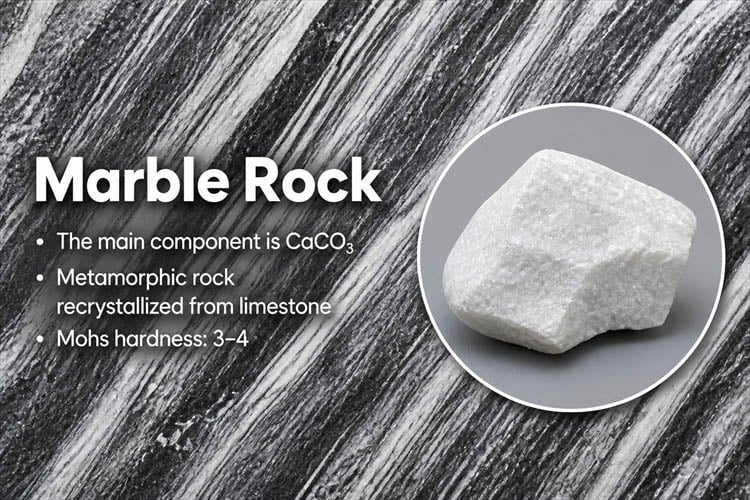
What Type of Rock Is Marble?
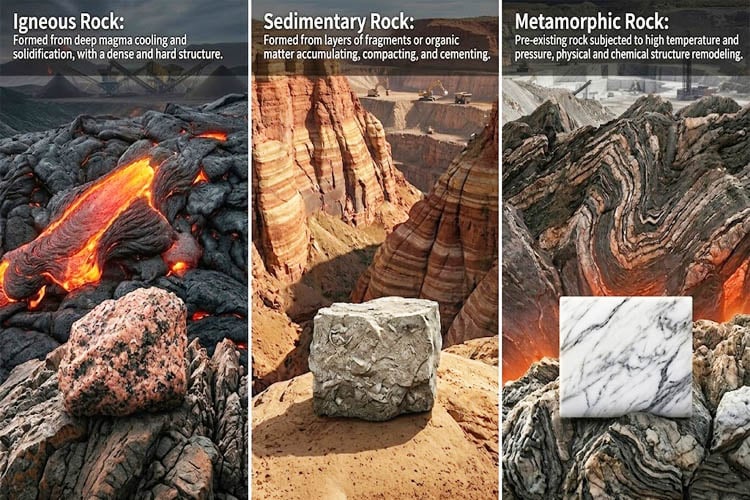
Marble is a metamorphic rock. That single sentence answers the largest question cluster around this topic — but the reasoning matters more than the label, because most confusion comes from marble's unusually close relationship with a sedimentary rock.
Metamorphic rocks form when an existing rock is altered by heat, pressure, or chemically active fluids without fully melting. In marble's case the protolith is almost always limestone or dolomite: a sedimentary carbonate deposited in shallow marine environments. When that limestone is buried and subjected to temperatures roughly in the 300–800 °C range and directed pressure, its calcite grains recrystallize into an interlocking mosaic. The chemistry barely changes; the fabric changes completely.
Why marble is not sedimentary and not igneous
The three rock families are distinguished by how they form, and marble fails two of the three tests in a useful way:
| Question | Answer | Why |
|---|---|---|
| Is marble a sedimentary rock? | No | Its grains are recrystallized, not deposited in layers. It has no bedding planes and no fossils preserved in growth position. |
| Is marble an igneous rock? | No | It never melted. There is no volcanic or intrusive cooling history, no glassy groundmass, no phenocrysts. |
| Is marble metamorphic? | Yes | Recrystallization under solid-state heat and pressure, inheriting carbonate chemistry from a sedimentary protolith. |
Field confirmation is quick. Marble effervesces (fizzes) when a drop of dilute hydrochloric acid is applied, because calcite dissolves and releases CO₂. Granite does not react. Marble also lacks the foliation — the layered, sheet-like parting — that defines slate, schist, and gneiss, because calcite recrystallizes into an equigranular mosaic rather than aligning into bands.
The limestone-marble confusion
Limestone and marble are the same chemistry in different fabrics, and the industry sometimes blurs the line commercially. Geologically, the boundary is recrystallization. A stone that still shows fossils, bedding, or fine mud-grade texture is limestone; a stone with interlocking crystalline grains that sparkle on a fresh break is marble. This is why the same quarry can sell "marble" that a geologist would call recrystallized limestone — and why grade specifications, not names, decide what you actually receive.
What Is the Chemical Formula of Marble?
The chemical formula of marble is CaCO₃ — calcium carbonate, the same formula as calcite, aragonite, and limestone. On a pure basis that works out to 56.0% CaO and 44.0% CO₂ by mass, which is why marble is also a lime feedstock: calcining it above roughly 800–900 °C drives off CO₂ and leaves quicklime (CaO).
Real marble is never pure CaCO₃. A commercial specification usually looks like this:
| Component | Typical range in commercial marble | What it does to the product |
|---|---|---|
| CaCO₃ | 50–98% | The useful fraction; higher purity means higher value |
| MgCO₃ | 0–45% (dolomitic grades) | Changes formula to CaMg(CO₃)₂; alters hardness and reactivity |
| SiO₂ | 0.2–3% | Abrasive to processing equipment; undesirable in high-brightness fillers |
| Fe₂O₃ | 0.02–0.5% | The main cause of yellowing and low whiteness |
| Al₂O₃ | 0.05–0.5% | Affects color and firing behavior |
Marble stone formula in dolomitic and impure varieties
When the dolomite fraction dominates, the formula becomes CaMg(CO₃)₂ — calcium magnesium carbonate. Dolomitic marble is harder and denser than pure calcite marble, and it behaves differently in calcination and in acid neutralization. Impurities such as quartz, mica, chlorite, pyrite, and graphite are not part of the formula; they are discrete minerals that control color, hardness, and whiteness. Graphite and bitumen produce grey and black marble; hematite and limonite produce red, pink, and yellow; serpentine-group minerals produce green.
A practical test protocol: XRF for the oxide table, acid-insoluble residue for the silicate fraction, and loss on ignition (LOI) as a cross-check — pure calcite LOI lands near 43.9%, and any shortfall signals either dolomite or silicate dilution.
How Marble Rock Forms
Marble forms by metamorphism of a carbonate protolith, and the two geological settings that produce commercial deposits behave differently.
Contact metamorphism occurs where an igneous intrusion heats the surrounding limestone. The resulting marble body is often small, irregular, and zoned — coarser near the intrusion, finer further out. Many high-whiteness deposits exploited for industrial filler fall into this category because the heat drives off organic matter and volatiles.
Regional metamorphism occurs during mountain building, where entire carbonate sequences are buried and deformed. These bodies are large, laterally continuous, and usually foliated at the outcrop scale even though the rock itself is not foliated — a distinction that matters during block extraction.
The recrystallization sequence runs from fine-grained, fossil-bearing limestone through a transitional "crystalline limestone" stage to coarse, sugary marble with grains of several millimeters. Grain size is not a quality defect; it is a processing variable. Coarse marble crushes and grinds more predictably, while very fine-grained, silica-bearing varieties increase wear on mill liners and media.
Deformation after metamorphism matters too. Marble is mechanically weak compared with silicate rocks, so it flows and shears readily; shear zones, clay-filled seams, and karst cavities are the most common reasons a promising deposit yields poor block recovery. That is why quarry assessment weighs recoverable block percentage, not just chemical assay.
Marble Rock Properties
Marble's properties explain both why architects want it and why processors must design circuits around it.
| Property | Typical value | Engineering consequence |
|---|---|---|
| Mohs hardness | 3–4 | Easy to crush and grind; low wear on jaw plates compared with granite |
| Density / specific gravity | 2.5–2.7 g/cm³ | Lower transport cost per cubic meter than granite (~2.6–2.8) |
| Porosity | 0.5–2% | Absorbs water and stains; sealants required in flooring |
| Water absorption | ~0.1–0.5% | Freeze-thaw risk in exterior applications if saturated |
| Compressive strength | roughly 60–120 MPa (sound commercial grades) | Adequate for cladding and flooring; below granite |
| Thermal stability | Poor to moderate | Spalls under direct heat; not a kitchen hot-pan surface |
| Acid resistance | Very low | Etches on contact with acid cleaners, citrus, vinegar |
| Color | White, grey, black, green, red, pink, yellow | Controlled by accessory minerals, not by CaCO₃ content |
Two of these properties drive most specification decisions. Acid sensitivity rules marble out of laboratories, commercial kitchens, and any environment with acidic cleaning regimes — a limitation granite and quartz do not share. Low hardness makes marble a dream to machine and a nightmare to keep polished in high-traffic floors, because calcite abrades quickly.
For industrial buyers the decisive properties are different ones: whiteness (ISO brightness), CaCO₃ content, Fe₂O₃ content, and grindability. A stone that is beautiful as a slab can be worthless as a filler if iron staining pushes brightness below the buyer's target, and a dull grey stone can be premium feedstock for paint and paper if it grinds bright and consistent.
Marble Rock vs Granite vs Quartz vs Limestone
Buyers searching for "marble rock" are usually comparing it with the other stones they have been quoted. Here is the comparison that matters, including the one row most articles omit — what each stone costs to process.
| Marble | Granite | Quartz (engineered) | Limestone | |
|---|---|---|---|---|
| Rock type | Metamorphic | Igneous | Engineered (quartz + resin) | Sedimentary |
| Main mineral | Calcite CaCO₃ | Quartz, feldspar, mica | ~90–95% quartz | Calcite CaCO₃ |
| Mohs hardness | 3–4 | 6–7 | ~7 | 3–4 |
| Acid resistance | Poor — etches | Good | Good | Poor |
| Heat resistance | Low | High | Moderate (resin limits it) | Low |
| Porosity | 0.5–2% | Low (<1%) | Near zero | Higher than marble |
| Typical use | Cladding, flooring, sculpture, GCC filler | Countertops, paving, aggregate | Countertops | Cladding, cement, aggregate |
| Processing wear | Low | High | n/a | Low |
The practical summary: choose marble for appearance and workability, granite for durability and heat, quartz for low maintenance, limestone for volume and cost. For industrial mineral buyers the comparison collapses into one question — which carbonate body gives the required brightness at the lowest cost per tonne of finished powder — and the answer depends on deposit chemistry rather than on the stone's commercial name.
What Is Marble Rock Used For?
Marble splits into two markets that barely overlap: dimension stone and industrial carbonate.
Dimension stone. Blocks are sawn into slabs and tiles for cladding, flooring, staircases, and bathroom surfaces; smaller pieces become tiles, mosaics, and structural elements in monuments and sculpture. The specification here is aesthetic and mechanical — color consistency across lots, absence of staining veins, flexural strength, and water absorption.
Industrial calcium carbonate. This is where tonnage lives. Crushed and ground marble becomes ground calcium carbonate (GCC), used as:
- Paper — filler and coating pigment, where brightness and particle size distribution control opacity and print quality.
- Paints and coatings — extender that improves hiding power, reduces TiO₂ demand, and controls gloss.
- Plastics and PVC — filler that improves stiffness and dimensional stability; stearate-coated grades improve dispersion.
- Adhesives and sealants — rheology control and cost reduction.
- Cement and concrete — raw meal component and, as fine powder, a supplementary cementitious material.
- Agriculture — liming agent to correct soil acidity.
- Environmental — flue-gas desulfurization and acid-water neutralization, where carbonate reactivity is the design parameter.
- Metallurgy — flux in iron and steelmaking.
- Construction aggregates — crushed marble as decorative aggregate, terrazzo chips, and railway ballast in some regions.
The same quarry can serve both markets, and the decision of which to serve is economic: a block that yields 60% sound slabs is worth far more as dimension stone, while fractured or off-color material becomes crusher feed.
How Marble Rock Is Processed: From Quarry to Powder
Marble's low hardness makes the processing circuit simpler and cheaper than granite's, but brightness control makes it less forgiving. The chain runs in four stages.
1. Extraction and primary crushing. Blocks are cut or blasted, then reduced by jaw or impact crushers to below roughly 100 mm. Because marble is soft and often sheared, feed variation is the main operational risk — clay seams choke crushers and contaminate product.
2. Secondary and tertiary crushing. Cone crushers or impact crushers bring material to 10–30 mm. Impact crushing is often preferred for carbonate rock because it produces a more cubical product with fewer fines than compression alone.
3. Grinding. This is where grade is created. Ball mills and vertical roller mills handle coarse to medium grades; ring-roll (Raymond-type) mills and ultrafine mills produce the fine and ultrafine fractions used in coatings and plastics. A typical industrial line targets d97 between 10 μm and 45 μm for fine grades, and below 10 μm for ultrafine.
4. Classification and surface treatment. Air classifiers cut the top size; whiteness is measured on the finished powder under ISO brightness; stearic acid coating is applied for plastic grades to reduce agglomeration and improve dispersion.
Two circuit decisions determine whether the plant makes money. Iron contamination control — liner and media selection, plus magnetic separation ahead of the mill — protects whiteness, which is the single most price-sensitive variable in filler markets. Fineness consistency — classifier efficiency rather than mill throughput — protects the customer relationship, because a coating grade that drifts coarse destroys opacity and gets rejected.
How to Specify and Test Marble Rock Quality
A marble specification that only says "white marble, high purity" is unusable. Six parameters do the actual work, and each maps to a test.
| Parameter | Why it matters | How to verify |
|---|---|---|
| CaCO₃ content | Defines the useful fraction and reactivity | XRF or complexometric titration |
| Whiteness / ISO brightness | Primary price driver for filler grades | Whiteness meter on pressed powder, ISO 2470 method |
| Fe₂O₃ content | Causes yellowing; the usual reason a grade is rejected | XRF |
| Acid-insoluble residue | Quartz and silicate content; drives equipment wear | Dissolution in dilute HCl, gravimetric residue |
| Particle size distribution | Controls opacity, gloss, and dispersion | Laser diffraction, reported as d50/d97 |
| Moisture | Affects weighing, coating, and storage | Loss on drying at 105 °C |
For dimension stone the list changes to flexural strength, water absorption, bulk density, and abrasion resistance, tested to the relevant ASTM or EN standard for the intended application.
One warning worth stating plainly: do not accept a certificate that reports only CaCO₃. Two deposits with identical carbonate content can differ by a factor of three in brightness and by an order of magnitude in iron, and the price gap between them follows the brightness, not the carbonate figure.
Where Marble Rock Is Found
Marble deposits are widespread because limestone is widespread — the constraint is not geological abundance but economic quality and logistics. Major producing and exporting countries include:
- Italy — Carrara and the Apuan Alps; the reference standard for white statuary marble.
- Turkey — one of the largest exporters of block and slab, with extensive travertine and marble quarries.
- China — large domestic production and consumption, with significant white and colored deposits.
- Greece, Spain, Portugal — long-established dimension stone industries with distinctive regional varieties.
- India — Makrana and Rajnagar marbles, plus the industrial carbonate belts of Rajasthan.
- Iran, Pakistan, Vietnam, Egypt, Brazil — significant and growing export volumes.
For industrial GCC, the more meaningful map is of captive and near-market plants: the economics of a filler plant are dominated by freight, so grinding capacity tends to sit within a few hundred kilometers of either the deposit or the customer.
A further practical point for buyers: a country's position in the dimension-stone trade tells you almost nothing about its industrial carbonate quality. Italy dominates white slab supply but imports filler-grade carbonate; India exports both blocks and GCC; Vietnam has become a significant source of bright, low-iron carbonate for coatings. Screen suppliers on deposit assay and plant location, not on the flag on the container.
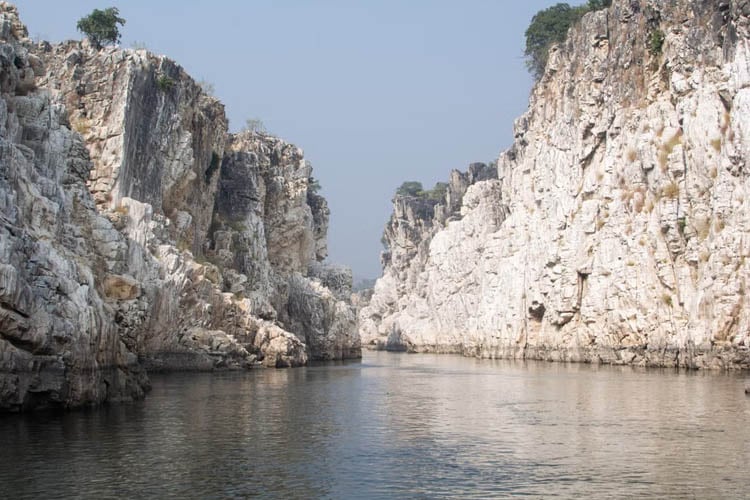
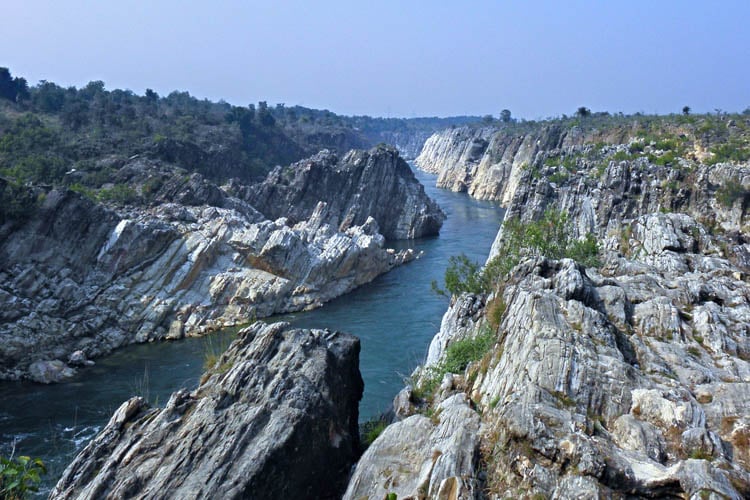
Marble Rocks at Bhedaghat, Jabalpur: The Famous Marble Gorge
The phrase "marble rocks" is also the name of a specific place, and that place accounts for a substantial share of global search demand for this topic: the Marble Rocks at Bhedaghat, near Jabalpur in Madhya Pradesh, India.
Here the Narmada River has cut a gorge through a belt of white and grey dolomitic marble, producing cliffs tens of meters high that visitors see by boat. The site is a well-known Indian landmark — promoted by Madhya Pradesh Tourism (MPT) as the Marble Rocks, Bhedaghat — and it is a genuinely instructive geology field example: the same recrystallized carbonate that industry grinds into filler appears here at landscape scale, with the river-polished surfaces revealing the crystalline fabric that defines marble.
If you are searching for the tourist destination rather than the material, note the distinction: the Bhedaghat gorge is a natural landmark and heritage site, not a quarry or a supplier. Commercially, the interesting detail is that the rock there is dolomitic — a reminder that "marble" describes a fabric, not a fixed chemical composition, which is precisely why industrial buyers specify CaCO₃ and MgCO₃ content rather than the stone's name.
Frequently Asked Questions
Which type of rock is marble?
Marble is a metamorphic rock. It forms when limestone or dolomite recrystallizes under heat and pressure in the solid state, producing an interlocking mosaic of calcite grains.
Is marble a sedimentary rock?
No. Marble's protolith — limestone — is sedimentary, which is the source of the confusion. Once recrystallization occurs, the rock is metamorphic: bedding and fossils are destroyed and replaced by crystalline fabric.
Is marble an igneous rock?
No. Marble never melts. Igneous rocks solidify from magma or lava; marble is altered in the solid state, so it retains carbonate chemistry inherited from its sedimentary parent.
Where are marble rocks found in India?
A: Marble Rocks at Bhedaghat (Jabalpur, Madhya Pradesh) is the most famous natural marble rock site in India.
What is marble stone formula in practice?
The nominal formula is CaCO₃, but commercial marble is a mixture: 50–98% CaCO₃ with variable MgCO₃, SiO₂, Fe₂O₃, and Al₂O₃. Those accessory oxides, not the formula, determine whether the stone is suitable for filler, cement, or dimension stone.
How hard is marble rock?
Mohs 3–4, with a density of 2.5–2.7 g/cm³. It is soft enough to carve and to grind economically, and soft enough to scratch and etch in service.
How can you tell marble from granite in the field?
Put a drop of dilute hydrochloric acid on a fresh surface. Marble fizzes as calcite dissolves and releases CO₂; granite does not react. Marble also scratches with a steel nail, which granite resists.
Can marble rock be crushed and ground industrially?
Yes — that is the basis of the ground calcium carbonate industry. Circuits typically combine jaw or impact crushing, then ball, vertical roller, or ring-roll milling with air classification to reach d97 of 45 μm down to below 10 μm.
Is marble rock expensive?
Price depends on which product you mean. Dimension blocks and slabs are priced by grade, color consistency, and recoverable yield; industrial GCC is priced per tonne by whiteness, fineness, and coating. The two markets are not comparable, and a cheap block can be an expensive powder if iron content limits brightness.
Conclusion
The single most useful thing to remember about marble rock is that its identity is textural. Limestone and marble share the formula CaCO₃; what separates them is recrystallization. That distinction explains the geology, the specification logic, and the processing economics all at once — and it is why serious buyers specify carbonate content, brightness, and iron rather than asking for "white marble."
If you are evaluating a marble or carbonate deposit for crushing, grinding, or a full powder line, the fastest way to a usable answer is a conversation about your target grade: feed size, required fineness, whiteness target, and annual tonnage. Talk to ZENITH's application engineers with those four numbers and you will get a circuit proposal rather than a brochure.







 24/7 Online