Demand for high-quality crushed stone and manufactured sand in Indonesia's construction market continues to grow. Mountain rock is a common local aggregate raw material, but Indonesian project sites present three unique challenges: undulating terrain (many mining areas are located in mountainous and hilly zones), long rainy seasons (high annual precipitation places demands on equipment protection and electrical layout), and unstable power supply (grid stability is limited in some regions).
These three challenges directly determine key design decisions of the project: how to lay out the site, how to configure the electrical control system, and how to select the number of crushing stages.
Taking a 450–500 TPH rock aggregate project delivered by ZENITH in Jakarta as a case study, this article details the process configuration and key design decisions of this production line, as well as implementation points worth attention in the early-stage solution design of similar projects in Southeast Asia.
Get Mountain Rock Aggregate Plant Solution
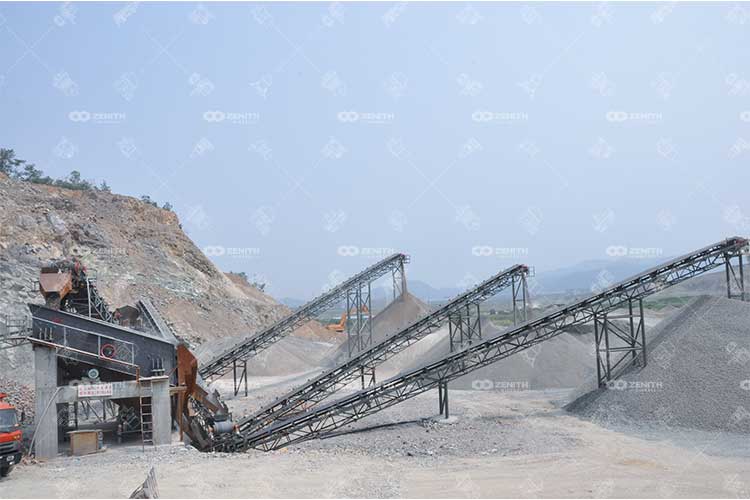
This project is located in Jakarta, Indonesia. It is a stationary rock aggregate production line delivered by ZENITH for the local Indonesian and surrounding national construction markets. The entire production line was designed and built to the standards of "industrialization, green operation, modularization, and intelligentization."
Click Here to Get Mountain Rock Aggregate Plant Solution
Main specifications:
· Raw material: Mountain rock
· Feed size: 0–800 mm, continuous gradation
· Product sizes: 0-5-10-20-30 mm
· Project capacity: 450–500 TPH, stationary
· Process configuration: F5X vibrating feeder + C6X jaw crusher + HST cone crusher + S5X vibrating screen
· Product applications: Construction sand and crushed stone for the Indonesian local and surrounding national construction markets
The designs offering the greatest reference value for similar rock aggregate projects are concentrated at two levels: the modular centralized layout of the secondary and tertiary crushers, and the equipment arranged on three tiers according to terrain plus a two-zone electrical control system positioned close to the energy consumption centers. These two design decisions directly determine the cost, footprint, energy consumption, and maintainability of a 450–500 TPH production line during both construction and operation.
Click Here to Get Mountain Rock Aggregate Plant Solution
The secondary crushing main machine (HST250S single-cylinder hydraulic cone crusher) and the two tertiary crushing main machines (HST250H single-cylinder hydraulic cone crushers) of the entire line are centrally arranged in a modular layout, combined with intelligent centralized control.
This layout directly delivers three benefits:
· Reduced belt conveyor and steel structure consumption — With the secondary and tertiary crushers placed closer together, the number and length of connecting belt conveyors decrease accordingly.
· Smaller production line footprint — Multiple main machines are compactly arranged.
· Improved energy consumption and maintenance efficiency — The impact of a single machine's maintenance on the entire line is more controllable.
· Site layout: The complete equipment set is arranged centrally in a modular fashion and distributed across three tiers according to the site terrain.
· Electrical control zoning: The electrical control system is divided into two zones. One electrical control room for primary crushing, and a shared electrical control room for secondary/tertiary crushing and screening.
· Proximity to energy consumption centers: Both electrical control rooms are positioned close to the energy consumption centers they serve: the primary crushing zone control room serves the primary crusher-the C6X jaw crusher; the secondary/tertiary crushing and screening zone control room serves the HST secondary cone crusher, HST tertiary cone crushers, and multiple S5X vibrating screens.
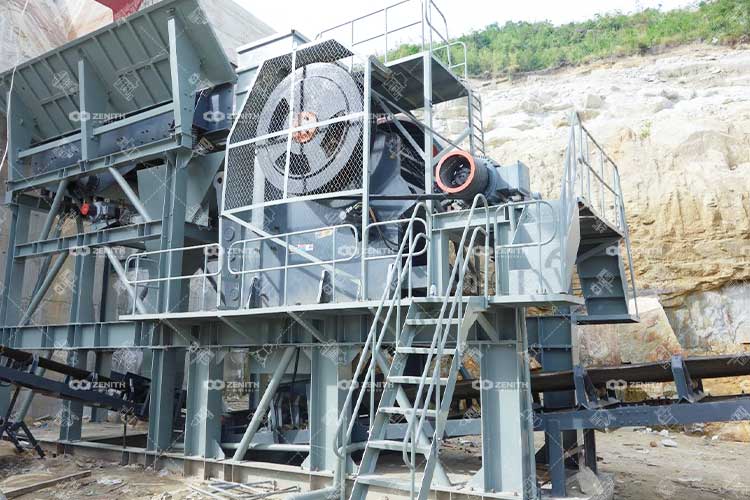
The direct benefits: the total lengths of both belt conveyors and electrical control cables are simultaneously reduced, lowering costs and energy consumption during construction and operation. This is the concrete implementation of "industrialization, green operation, modularization, and intelligentization" at the production line level.
Based on process requirements, the project adopts three-stage crushing: primary crushing → secondary crushing → tertiary crushing → screening.
Click Here to Get Mountain Rock Aggregate Plant Solution
The entire flow is organized around two objectives:
1. Crushing the 0–800 mm continuous-gradation raw ore down to the 0–30 mm finished product specifications in sequence;
2. Through closed-circuit circulation, returning the screen oversize from secondary and tertiary crushing to their corresponding crushing zones, achieving stable classification of multiple finished product sizes: 0–5 mm, 5–10 mm, 10–20 mm, and 20–30 mm.
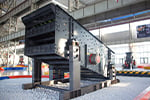
ZENITH F5X vibrating feeder: Conveys the 0–800 mm raw ore continuously and steadily; pre-screens out most of the 0–120 mm waste soil through the bar grizzly.
ZENITH C6X jaw crusher: The primary crushing main machine, crushing material larger than 120 mm on top of the bars to a size acceptable for secondary crushing.
Flow: Dump trucks unload the raw ore into the raw material bin → material is conveyed continuously and steadily by the F5X feeder → during feeding, the 0–120 mm waste soil is screened out through the bar grizzly (going directly to the subsequent pre-screening process), while material larger than 120 mm enters the C6X125 jaw crusher for primary crushing.
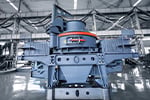
Secondary crushing — ZENITH HST cone crusher: The secondary crushing main machine, receiving the primary crushed product.
Tertiary crushing — ZENITH HST cone crusher: The tertiary crushing main machines, two units in parallel; screen oversize returns to form a closed circuit.
Flow: Material from the primary crushing module is conveyed by belt conveyor to the secondary cone crusher → secondary crushed material enters the secondary crushing screening; screen oversize larger than 30 mm passes through the steel-structure transfer bin → enters the two parallel tertiary cone crushers for crushing → enters the tertiary crushing screening; screen oversize larger than 30 mm from tertiary screening returns once again to the tertiary cone crushers, thus forming the closed-circuit crushing and screening loop of the tertiary cone crushers.
The ZENITH S5X vibrating screen performs three functions:
· Multi-size classification after secondary crushing — screening out the 20–30 mm finished product and feeding the 0–20 mm material to the next screening stage;
· Tertiary crushing screening and closed-circuit circulation;
· Pre-screening of the 0–120 mm waste soil from below the bar grizzly.
Raw material is unloaded by dump trucks → into one C1 raw material bin → vibrating feeder, with a bar gap of 120 mm; material smaller than 120 mm → enters the screening machine, where 0–10 mm waste soil is screened out, and screen oversize larger than 10 mm returns to the discharge belt conveyor of the primary jaw crusher; material larger than 120 mm on top of the bars → jaw crusher → transfer bin → secondary cone crusher → vibrating screen → 20–30 mm finished product screened out and sent to the finished product storage, 0–20 mm → vibrating screen for finished product screening → finished products of 0-5-10-20 mm screened out and sent to the finished product storage. Finally, screen oversize larger than 30 mm → steel-structure transfer bin → tertiary cone crusher → vibrating screen → screen oversize larger than 30 mm → returns once again to the tertiary cone crusher.
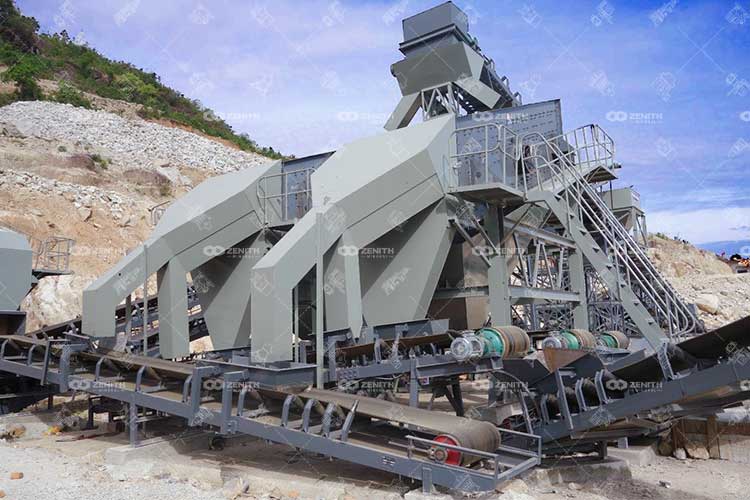
Similar rock aggregate projects, especially those with terrain elevation differences and those supplying the Indonesian and surrounding construction markets should focus on the following design points:
Click Here to Get Mountain Rock Aggregate Plant Solution
When secondary and tertiary crushing main machines are centrally arranged in a modular layout with intelligent centralized control, the connecting belt conveyors and steel structure consumption between main machines are directly reduced, while the production line footprint is also minimized.
For projects with terrain elevation differences on site, an overall layout of three tiers following the terrain is more economical than large-scale site leveling:
· Small material drop — the material drop between tiers is small, reducing the number of belt conveyor lifting sections;
· Compressed connecting belt conveyor lengths — with the secondary and tertiary crushing modules centrally arranged, the connecting belt conveyor lengths between main machines decrease accordingly;
· Clear inspection and maintenance routes — crushing and screening equipment are relatively concentrated.
The three tiers of this project were determined based on the site slope and equipment specifications. For similar projects, the number of tiers and the tier placement of each piece of equipment must be verified by the designer according to site slope, geological conditions, and equipment specifications.
The direct benefits —
The total length of electrical control cables is reduced, and cable costs decrease accordingly; meanwhile, inspection points are concentrated, facilitating troubleshooting and rapid daily operational response. Overall design that coordinates electrical control cables, plant buildings, and other auxiliary factors is the foundation of long-term reliable production line operation.
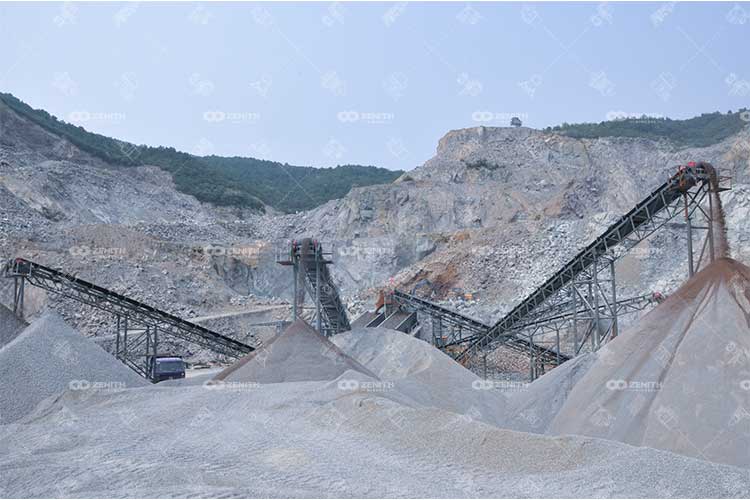
The 450–500 TPH rock aggregate project delivered by ZENITH in Jakarta, Indonesia, is designed around the positioning of "industrialization, green operation, modularization, and intelligentization" . The complete solution is built around a three-stage closed-circuit crushing process, combined with specific decisions such as the modular centralized layout of secondary and tertiary crushing, achieving integrated coordination from equipment configuration and site design to the electrical control solution.
If your project is located in Southeast Asia or under similar terrain conditions, feel free to contact ZENITH for a customized solution.
Click Here to Get Mountain Rock Aggregate Plant Solution


Indonesia is one of the largest aggregate markets in Southeast Asia, and rock aggregate project sites often face challenges such as undulating terrain, long rainy seasons, and unstable power supply. Taking a 450–500 TPH rock aggregate project delivered by ZENITH in Jakarta as a case study, this article details the process configuration and key design decisions of this production line, as well as implementation points worth attention in the early-stage solution design of similar projects in Southeast Asia.
A comprehensive procurement guide for evaluating and selecting top crusher manufacturers. Covers CAPEX vs. TCO analysis, spare parts supply chains, flowsheet integration, and comparison of Metso, Sandvik, Terex, Astec, and ZENITH.
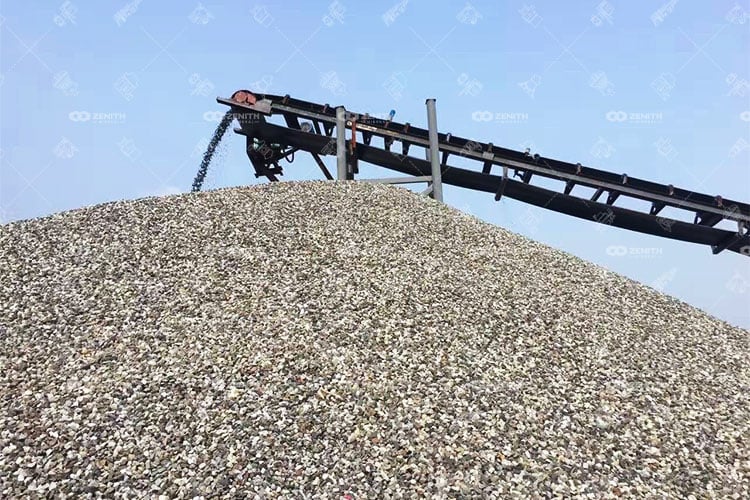
Taking the river pebble crushing plant that ZENITH has applied multiple times in the Philippines as an example, this article explains the complete logic of the "screen-before-crush" process, and how the entire production line uses only three main belt conveyors through a streamlined layout to control investment. For projects using river pebbles as the raw material, this approach offers direct design reference value.
Fill your requirements here, and we'll send the custmized solution and quotation to you by the reserved contact information.
Copyright ©2000-2026 SHANGHAI ZENITH MINERAL CO.,LTD.

 WhatsApp

 24/7 Online