
 WhatsApp
In modern open-pit and underground mining operations, material handling accounts for up to 40% to 50% of total operational costs (OPEX). As mines expand, pit depths increase, and environmental compliance tightens, selecting the most cost-effective continuous ore transportation system is a critical strategic decision for mine owners and EPC engineering firms.
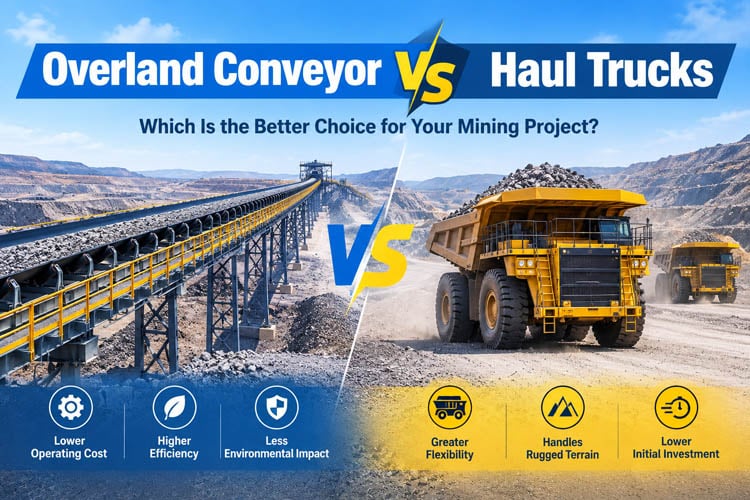
Historically, diesel-powered haul trucks have been the standard choice due to low initial capital requirements and operational flexibility. However, for continuous bulk material transport across distances exceeding 1–3 kilometers, Overland Belt Conveyors (OBCs) present a compelling Total Cost of Ownership (TCO) advantage.
This article provides an engineering and economic analysis comparing Overland Belt Conveyors and Haul Truck fleets, evaluating Capital Expenditure (CAPEX), Operational Expenditure (OPEX), life-cycle economics, and overall operational efficiency.
1. Capital Expenditure (CAPEX) Comparison
When evaluating initial investment costs, haul trucks often appear cheaper on paper. However, a comprehensive CAPEX evaluation must account for secondary infrastructure, fleet replacements, and civil engineering requirements.
| Cost Component | Haul Truck Fleet | Overland Belt Conveyor System |
|---|---|---|
| Primary Equipment | Diesel Rigid Haul Trucks (Fleet sized for TPH) | Conveyor Structure, Belting, Drives, Gearboxes, Idlers |
| Infrastructure | Wide haul road construction, drainage, runaway ramps | Right-of-way (ROW) clearance, civil foundations, transfer towers |
| Auxiliary Equipment | Water trucks, road graders, fuel stations, maintenance bays | Transformer substations, power lines, control/PLC systems |
| Lifecycle CAPEX | High re-investment (Fleet replacement every 5–7 years) | Low re-investment (Belt replacement every 8–12 years; structure lasts 20+ years) |
Key Takeaway on CAPEX:
- Trucks have lower upfront costs but require recurring capital injections every few years to replace degraded units.
- Overland Conveyors require a higher initial capital outlay for engineering, structures, and belt installations, but offer a 20+ year lifecycle asset with minimal structural replacement costs.
2. Operational Expenditure (OPEX) Breakdown
The true economic divergence between continuous conveyor systems and flexible truck fleets lies in recurring operational expenses. Over a 10-to-20-year mine lifespan, OPEX overwhelmingly dominates TCO.
Typical OPEX Breakdown (5km Distance @ 1,000+ TPH)
Haul Trucks
- Diesel Fuel (45%)
- Labor & Drivers(30%)
- Tires & Parts (20%)
- Road Maint (5%)
Overland Conveyor
- Electricity (50%)
- Maintenance (30%)
- Belt & Idlers (15%)
- Monitoring (5%)
A. Fuel & Energy Costs
- Haul Trucks: Diesel fuel consumption scales exponentially with haul distance and uphill gradients. Fuel prices are volatile, introducing severe budgetary risk.
- Overland Conveyors: Driven by high-efficiency electric motors (often equipped with Variable Frequency Drives - VFDs). Additionally, downhill slope conveyors can utilize regenerative braking to produce electricity back into the mine's power grid.
B. Labor Requirements
- Haul Trucks: Requires a large team of skilled operators working in shifts, along with dedicated road maintenance crews and diesel mechanics.
- Overland Conveyors: Fully automated continuous systems requiring only a small team of monitoring technicians and routine maintenance crew.
C. Consumables & Maintenance
- Haul Trucks: Heavy off-the-road (OTR) tires represent one of the single largest continuous operational expenses, alongside engine overhauls, brake pads, and hydraulic fluids.
- Overland Conveyors: Primary wear parts are conveyor belts, impact rollers, and idlers. Predictive condition monitoring systems (e.g., thermal imaging, acoustic idler sensing) drastically reduce unscheduled downtime.
3. TCO Case Study: 5 km Route at 1,200 TPH Capacity
To illustrate the financial impact, consider a medium-scale hard rock mine transporting 1,200 metric tons per hour (TPH) over a 5-kilometer distance over a 15-year operational lifecycle.
Total Cost of Ownership (TCO) = CAPEXinitial + ∑t=1N [ (OPEXt + CAPEXsustaining) / (1 + r)t ]
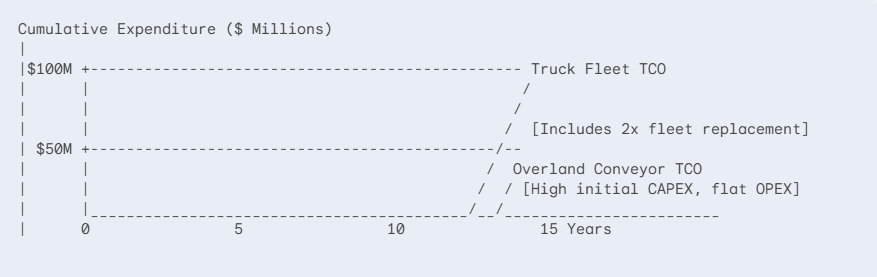
Financial Comparison Summary (15-Year Life of Mine):
- 1. Payback Period: The initial CAPEX delta of the overland conveyor is typically recovered within 2.5 to 4 years of continuous operation due to massive daily OPEX savings.
- 2. Cost per Ton-Kilometer ($/t·km):
- Haul Truck Fleet: $0.12 - $0.25 per t·km (varies with diesel price and grade).
- Overland Conveyor: $0.03 - $0.07 per t·km (up to 70% reduction in transport cost per ton).
4. Environmental, Safety, and Operational Advantages
Beyond direct financial figures, overland conveyors offer distinct operational advantages that lower indirect risks:
- Decarbonization & ESG Compliance: Electric conveyors drastically lower Scope 1 emissions compared to diesel trucks, helping mines align with global carbon reduction mandates.
- All-Weather Reliability: Conveyor systems operate continuously during heavy rain, snow, fog, or mud, whereas haul trucks face severe safety hazards and operational shutdowns.
- Safety & Dust Control: Enclosed conveyor galleries eliminate haul road traffic collision risks and significantly reduce airborne fugitive dust generation.
- Footprint & Gradient Limits: Overland conveyors can negotiate steeper inclines (up to 18° - 22°) compared to haul trucks (typically max 8% - 10% grade), significantly shortening the total transport route over mountainous terrain.
5. Frequently Asked Questions (FAQs)
Q1: What is the typical payback period for replacing haul trucks with an overland conveyor?
A: For high-capacity mines (500+ TPH) over distances greater than 3 kilometers, the initial CAPEX of an overland conveyor is usually paid back within 2.5 to 4 years due to the massive reduction in fuel, labor, and tire expenses.
Q2: Can an overland conveyor handle steep terrain that haul trucks cannot?
A: Yes. Haul trucks are generally limited to grades of about 8% to 10%. Overland belt conveyors can safely transport material at angles of up to 18° to 22° (and sometimes steeper with specialized cleated belts), which can significantly reduce the route distance in mountainous or deep-pit operations.
Q3: How do overland conveyors perform in extreme weather?
A: Overland conveyors can be fully enclosed and operate continuously in rain, snow, and fog. Haul trucks, on the other hand, face severe traction issues and safety hazards in bad weather, often forcing the mine to halt operations.
Q4: What are the main maintenance costs for an overland conveyor system?
A: The primary ongoing costs are the replacement of wear items such as the conveyor belt (every 8–12 years) and idler rollers. However, modern predictive monitoring (using thermal imaging and acoustic sensors) keeps unplanned downtime and maintenance labor exceptionally low compared to maintaining a fleet of diesel trucks.
Conclusion: When Should You Choose an Overland Conveyor?
While haul trucks remain ideal for dynamic pit movement, short distances, and low-tonnage applications, Overland Belt Conveyors dominate the economics when your project meets the following criteria:
- Transport Distance: ≥ 100 meters (and especially systems ≥ 500 meters).
- Throughput Capacity: Continuous flow required at ≥ 500 TPH.
- Mine Life: Long-term project horizon (≥ 5 years).
- Terrain Constraints: Steep climbs, river crossings, or rugged terrain where haul road construction is prohibitively expensive.
Optimize Your Mine Logistics with Custom Conveyor Engineering
Are you evaluating material transport options for your mine site or port terminal?
Our engineering team specializes in designing high-capacity, long-distance Overland Conveyors (≥ 500m), Downhill Regenerative Systems, and Port Bulk Handling Facilities.
Contact Our Bulk Handling Engineers Today to request a customized TCO evaluation, preliminary layout engineering, or budget estimation for your project.




 24/7 Online