
 WhatsApp
Hard rock gold occurs within solid rock formations such as quartz veins and sulfide-bearing ores. Unlike placer gold, which is often naturally liberated through weathering and erosion, rock gold is commonly locked inside quartz, sulfide minerals, or other host minerals. It must therefore be crushed, ground, and treated using suitable mineral processing and gold extraction methods.
There is no single process flow that works for every rock gold deposit. Some ores can be treated by gravity separation and direct cyanide leaching, while others require flotation to concentrate gold-bearing sulfide minerals. Refractory gold ores may need additional pretreatment, such as pressure oxidation, roasting, or biological oxidation, before gold can be recovered effectively.
This guide explains the main types of rock gold ore, the common processing stages, the equipment used, and how to select a suitable gold processing method.
1. What Is Hard Rock Gold?
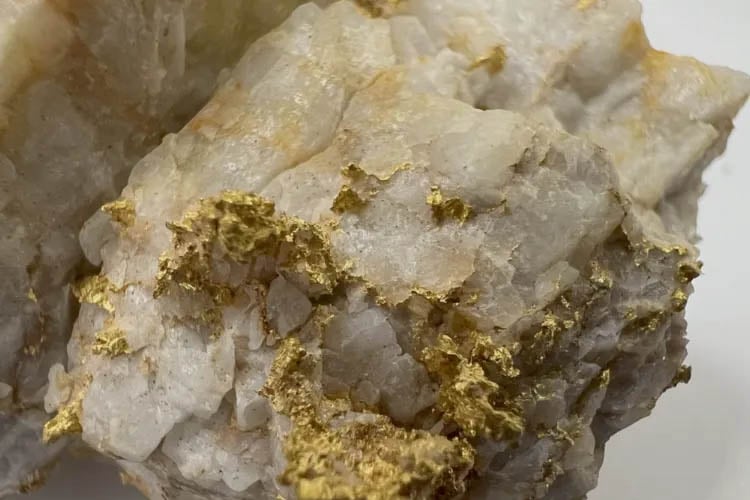
Hard rock gold (or lode gold) refers to gold contained in solid geological formations. It is commonly found in quartz veins, altered rocks, and sulfide mineral deposits.
Gold in hard rock ores can occur in several forms:
- Free-milling gold: Gold particles are sufficiently exposed or liberated after grinding and can often be recovered through gravity separation, cyanide leaching, or a combination of both.
- Sulfide-associated gold: Gold occurs within or alongside minerals such as pyrite and arsenopyrite. Flotation may be used to concentrate the gold-bearing sulfides.
- Refractory gold: Gold is extremely fine or physically and chemically locked within sulfide minerals or other mineral structures, making conventional leaching less effective without pretreatment.
The way gold occurs in the ore is more important than the deposit's name when selecting a processing method.
2. Main Types of Hard Rock Gold Ore
2.1 Quartz Vein Gold Ore
Quartz vein gold deposits are among the well-known types of hard rock gold deposits. Gold may occur as visible particles, fine inclusions, or disseminated grains within quartz veins and associated minerals.
Depending on the degree of gold liberation, a suitable processing route may include:
- Crushing and grinding to reduce particle size.
- Gravity separation to recover liberated coarse gold.
- Cyanide leaching to extract suitable exposed gold.
- Flotation when gold is associated with recoverable sulfide minerals.
Not all quartz vein ores require flotation. Mineralogical testing is necessary to determine whether gold is free-milling or associated with other minerals.
2.2 Sulfide-Hosted Gold Ore
In sulfide-hosted gold ores, gold is associated with minerals such as pyrite, arsenopyrite, and other sulfides. Some gold particles are exposed, while others occur as microscopic inclusions or are locked inside sulfide mineral structures.
Flotation is commonly used to separate gold-bearing sulfide minerals from gangue and produce a smaller, higher-grade concentrate.
The concentrate may then be treated further. Depending on its mineralogy, options may include fine grinding, oxidation, or an appropriate leaching process.
2.3 Refractory Gold Ore
Refractory gold ores are difficult to process using conventional cyanide leaching because the gold is not sufficiently accessible to the leaching solution.
Common causes include:
- Gold encapsulated in pyrite or arsenopyrite.
- Extremely fine gold particles within sulfide minerals.
- Carbonaceous matter that can adsorb dissolved gold during leaching.
- Mineralogical features that limit reagent access or gold dissolution.
Pretreatment may be required to expose the gold before leaching. Common options include roasting, pressure oxidation (POX), and biological oxidation (BIOX). The appropriate method depends on sulfide content, arsenic content, carbonaceous material, environmental requirements, and project economics.
3. Hard Rock Gold Processing Flow
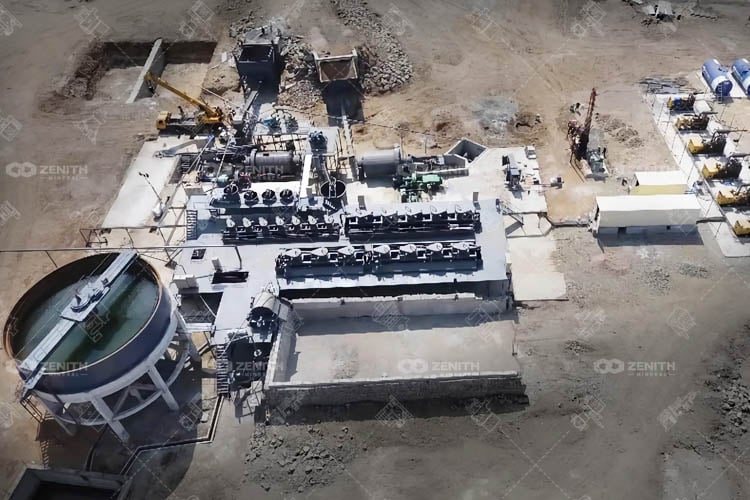
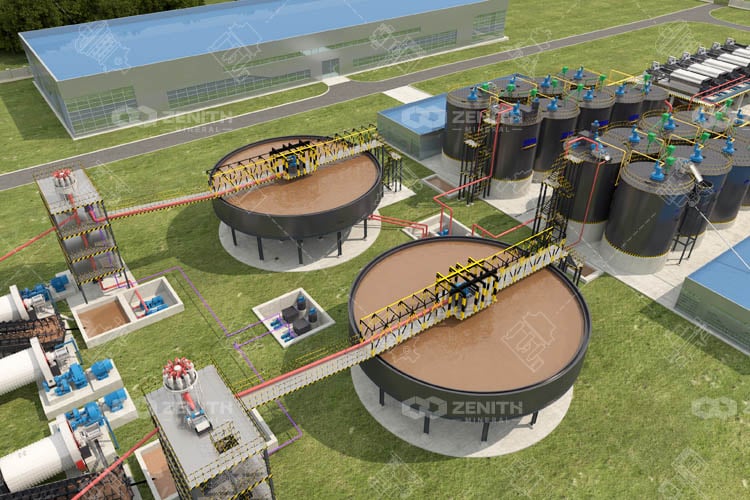
A typical hard rock gold processing plant may include crushing, grinding, classification, gravity separation, flotation or leaching, and final gold recovery. However, not every operation uses all these stages.
3.1 Crushing
The first stage is to reduce large rocks into smaller particles suitable for grinding.
A typical crushing circuit may include:
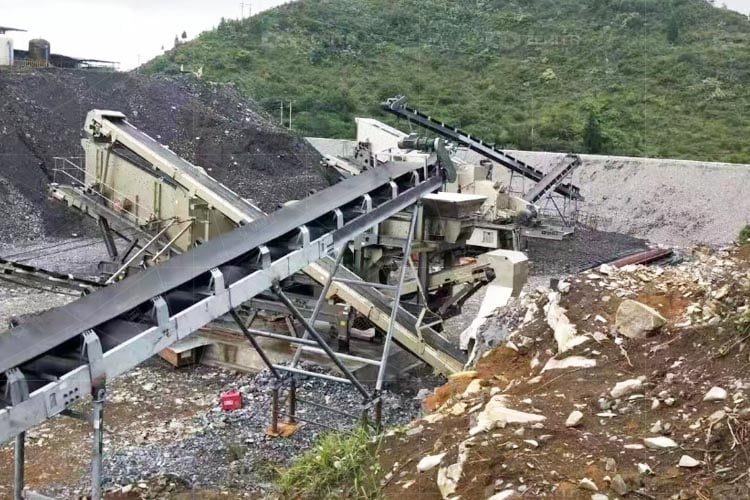
- Jaw crusher: Used for primary crushing of large, hard ore.
- Cone crusher: Used for secondary or tertiary crushing to produce a smaller and more uniform product.
- Vibrating screen: Separates particles by size and can return oversize material to the crusher for further reduction.
The crushing circuit should provide a consistent feed size for the grinding stage. The required crushing ratio and product size depend on ore hardness, processing capacity, and the selected grinding equipment.
3.2 Grinding and Classification
Crushed ore is ground to liberate gold particles from the surrounding minerals. Ball mills are widely used in hard rock gold processing plants, while other grinding technologies may be selected according to plant capacity and ore characteristics.
Classification equipment, such as hydrocyclones, separates fine particles from coarse particles. Coarse material can return to the mill for further grinding, while material meeting the target size moves to the next process stage.
Grinding must be carefully optimized. Insufficient grinding may leave gold locked in the host minerals, while excessive grinding can increase energy consumption and create slimes that complicate downstream separation.
3.3 Gravity Separation
Gravity separation is useful when the ore contains sufficiently coarse or liberated gold particles.
Common equipment includes:
- Jig separators: Recover relatively coarse, liberated gold from suitable particle-size fractions.
- Centrifugal concentrators: Recover fine and small liberated gold particles by using enhanced centrifugal forces.
- Shaking tables: Upgrade gravity concentrates and remove lighter gangue minerals.
Gravity separation may be installed before or after grinding, depending on when gold is liberated. Recovering coarse free gold early can reduce the amount of gold entering downstream circuits and may improve overall process efficiency.
However, gravity separation cannot recover gold that remains locked inside unliberated sulfide or gangue particles.
3.4 Flotation
Flotation is commonly used when gold is associated with sulfide minerals that can be selectively floated.
In a flotation circuit, suitable reagents and air bubbles are used to make target minerals attach to bubbles and rise into the froth, while much of the gangue remains in the pulp.
A typical flotation circuit may include:
- Conditioning the ground ore with appropriate reagents.
- Rougher flotation to recover the majority of the target sulfide minerals.
- Scavenger flotation to recover additional valuable minerals from rougher tailings.
- Cleaner flotation to upgrade the concentrate.
The resulting gold-bearing sulfide concentrate can be treated further. Depending on its mineralogy, options may include regrinding, direct leaching, oxidation pretreatment, or off-site smelting.
Flotation is not automatically required for every hard rock gold ore. It is most useful when mineralogical testing confirms that gold can be concentrated with floatable minerals.
3.5 Cyanide Leaching
Cyanide leaching is widely used to extract gold from suitable ores and concentrates. In this process, gold dissolves into a cyanide solution under controlled chemical and operating conditions.
Two common approaches are:
- CIL (Carbon-in-Leach): Activated carbon is added directly to the leaching tanks, allowing gold dissolution and adsorption to occur in the same circuit.
- CIP (Carbon-in-Pulp): Gold is first leached into solution, and activated carbon is then used in separate adsorption stages to recover dissolved gold.
The choice between CIL, CIP, and other leaching arrangements depends on ore characteristics, solution chemistry, carbonaceous material, and plant design.
Cyanide is a hazardous chemical. Industrial cyanidation requires appropriate engineering controls, trained operators, monitoring, detoxification where required, and compliance with applicable environmental and safety regulations.
3.6 Gold Recovery and Smelting
After gold has been dissolved and adsorbed onto activated carbon, the loaded carbon is processed to recover gold from the solution. Gold is then typically recovered through electrowinning or another suitable recovery method.
The resulting gold-bearing material is smelted to produce doré bars or another intermediate product for further refining.
Where gold is recovered through flotation and concentrate treatment rather than whole-ore leaching, the downstream route may be different. The final process should match the concentrate's mineralogy and the available treatment facilities.
4. Processing Methods for Different Types of Rock Gold
The most suitable process depends on gold liberation, mineral association, and the response of the ore to gravity separation, flotation, and leaching.
4.1 Quartz Vein Gold Processing
For quartz vein ores containing liberated or easily liberated gold, a possible process flow is:
Crushing → Grinding → Gravity Separation → Cyanide Leaching → Gold Recovery
Gravity separation can recover coarse free gold before the leaching stage. The remaining material may be treated by direct leaching if test work confirms that gold is accessible.
If the ore contains significant gold-bearing sulfides, flotation may be added:
Crushing → Grinding → Flotation → Concentrate Treatment → Gold Recovery
The final choice should be based on gold deportment and metallurgical test results.
4.2 Sulfide Gold Processing
For gold associated with pyrite, arsenopyrite, or other sulfide minerals, flotation is often used to concentrate the valuable sulfides.
A possible process flow is:
Crushing → Grinding → Flotation → Concentrate Regrinding or Pretreatment → Gold Extraction
If gold is exposed after grinding, the concentrate may be suitable for direct leaching. If gold remains locked inside sulfide minerals, oxidation pretreatment may be necessary.
The treatment route should also consider arsenic content and the requirements for managing sulfur-bearing residues.
4.3 Refractory Gold Processing
Refractory ores generally require additional treatment to make gold accessible to the leaching solution.
A simplified process flow may be:
Crushing → Grinding → Flotation or Other Concentration → Oxidation Pretreatment → Gold Leaching → Gold Recovery
Common pretreatment options include:
- Roasting: Uses controlled high temperatures to oxidize sulfide minerals. It requires careful control of gas emissions and treatment of arsenic-bearing materials.
- Pressure oxidation (POX): Uses elevated temperature and pressure in an oxidizing environment to break down sulfide minerals.
- Biological oxidation (BIOX): Uses microorganisms to oxidize sulfide minerals under controlled conditions.
These technologies require more complex plant systems and higher capital and operating costs than many conventional free-milling gold processes. Their suitability must be demonstrated through metallurgical testing and economic evaluation.
5. Key Equipment for Rock Gold Processing
| Equipment | Main Function | Typical Application |
|---|---|---|
| Jaw crusher | Primary crushing | Large hard rock feed |
| Cone crusher | Secondary or tertiary crushing | Reducing crushed ore to a suitable grinding size |
| Vibrating screen | Size separation | Crushing circuit screening |
| Ball mill | Grinding | Liberating gold from host minerals |
| Hydrocyclone | Classification | Controlling grinding circuit particle size |
| Jig separator | Gravity concentration | Recovering suitable coarse free gold |
| Centrifugal concentrator | Fine gravity recovery | Recovering fine liberated gold |
| Flotation machine | Sulfide mineral separation | Concentrating gold-bearing sulfides |
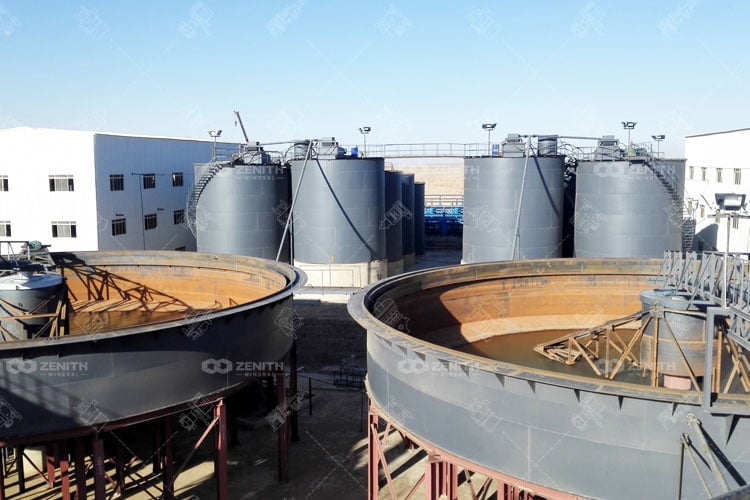
| Thickener | Solid-liquid separation | Concentrate or tailings thickening |
| Leaching tank | Gold dissolution | Suitable free-milling ores or concentrates |
| Carbon adsorption equipment | Gold recovery from solution | CIL or CIP circuits |
| Electrowinning equipment | Gold recovery from solution | Producing gold-bearing cathode material |
The equipment list is indicative rather than universal. A free-milling ore may need a relatively straightforward gravity and leaching circuit, while a refractory sulfide ore may require flotation and oxidation pretreatment.
6. How to Choose the Right Hard Rock Gold Processing Method
Selecting a gold processing method should begin with ore characterization rather than equipment selection.
6.1 Conduct Mineralogical Analysis
Mineralogical analysis helps determine:
- Whether gold is free or locked.
- Which minerals host the gold.
- The size and distribution of gold particles.
- The presence of sulfides, arsenic-bearing minerals, or carbonaceous matter.
- The degree of liberation at different grinding sizes.
This information provides the basis for selecting a suitable process.
6.2 Carry Out Metallurgical Testing
Representative samples should be tested to evaluate the performance of potential processing methods.
Depending on the ore, test work may include:
- Comminution and grinding tests.
- Gravity recovery tests.
- Flotation tests.
- Cyanide leaching tests.
- Diagnostic leaching.
- Refractory ore pretreatment tests.
Testing should evaluate not only gold recovery but also concentrate grade, reagent consumption, energy demand, and the characteristics of tailings and residues.
6.3 Compare Technical and Economic Factors
A technically effective process may not always be the most economical option.
Important considerations include:
- Ore hardness and grinding energy requirements.
- Gold grade and mineralogical characteristics.
- Expected recovery and concentrate quality.
- Reagent and water consumption.
- Equipment investment and maintenance.
- Labor, power, and infrastructure costs.
- Environmental controls and residue management.
- Availability of smelting or concentrate treatment facilities.
The final process should balance recovery performance, operational reliability, investment, and environmental compliance.
7. Factors Affecting Gold Recovery and Processing Costs
7.1 Ore Hardness and Grindability
Harder ores generally require more energy for crushing and grinding. The grinding circuit can therefore have a major influence on operating costs.
7.2 Gold Liberation
Gold must be sufficiently exposed for gravity separation or leaching to work effectively. The required grinding size depends on how gold occurs in the ore.
7.3 Sulfide and Arsenic Content
High sulfide or arsenic content can complicate processing, concentrate treatment, and residue management. Some ores require specialized pretreatment and additional environmental controls.
7.4 Reagent Consumption
Reagent consumption depends on ore chemistry, mineral composition, and process conditions. Excessive consumption can increase operating costs and indicate that the process needs further optimization.
7.5 Water, Energy, and Environmental Requirements
Grinding, flotation, and leaching circuits require reliable utilities and suitable residue management systems. Water recycling, dust control, tailings management, and chemical safety should be considered during plant design.
8. FAQs About Hard Rock Gold Processing
Q1: What is the best method for processing hard rock gold?
There is no universal best method. Free-milling ores may be processed using gravity separation and cyanide leaching, while sulfide-associated ores may require flotation. Refractory ores may need oxidation pretreatment before gold extraction.
Q2: What equipment is needed for a rock gold processing plant?
Common equipment includes jaw crushers, cone crushers, vibrating screens, ball mills, hydrocyclones, gravity concentrators, flotation machines, leaching tanks, and gold recovery equipment. The final equipment list depends on the ore and selected process.
Q3: Does all rock gold need flotation?
No. Flotation is mainly used when gold is associated with sulfide minerals that can be concentrated through flotation. Some free-milling ores can be treated by gravity separation and direct leaching without a flotation stage.
Q4: Why is grinding important in gold processing?
Grinding reduces ore particle size and helps liberate gold from its host minerals. The correct grinding size improves the performance of downstream gravity separation, flotation, or leaching.
Q5: What is refractory gold ore?
Refractory gold ore is ore in which gold cannot be recovered efficiently by conventional leaching without additional treatment. Gold may be encapsulated in sulfide minerals or affected by carbonaceous material. Pretreatment may be needed to improve accessibility.
Q6: What is the difference between CIL and CIP?
Both processes use activated carbon to adsorb dissolved gold from a leach pulp. In CIL, leaching and carbon adsorption take place together in the same circuit. In CIP, leaching is carried out before the pulp enters separate carbon adsorption stages.
Q7: How can I improve gold recovery from hard rock ore?
Start by identifying how gold occurs in the ore. Optimize crushing and grinding, evaluate gravity recovery for liberated gold, use flotation where appropriate, and conduct leaching or pretreatment tests. Regular sampling of concentrates and tailings helps identify losses.
Conclusion
Rock gold processing requires a process flow that matches the mineralogical characteristics of the ore. Crushing and grinding prepare the material for separation, while gravity concentration, flotation, cyanide leaching, and oxidation pretreatment are selected according to how gold occurs.
For free-milling ores, a relatively simple gravity and leaching circuit may be sufficient. Sulfide-associated ores may benefit from flotation, while refractory ores often require more advanced pretreatment.
Before investing in a rock gold processing plant, conduct representative sampling, mineralogical analysis, and metallurgical testing. These steps help identify the most suitable equipment configuration, improve gold recovery, and avoid unnecessary capital and operating costs.


 24/7 Online