
 WhatsApp
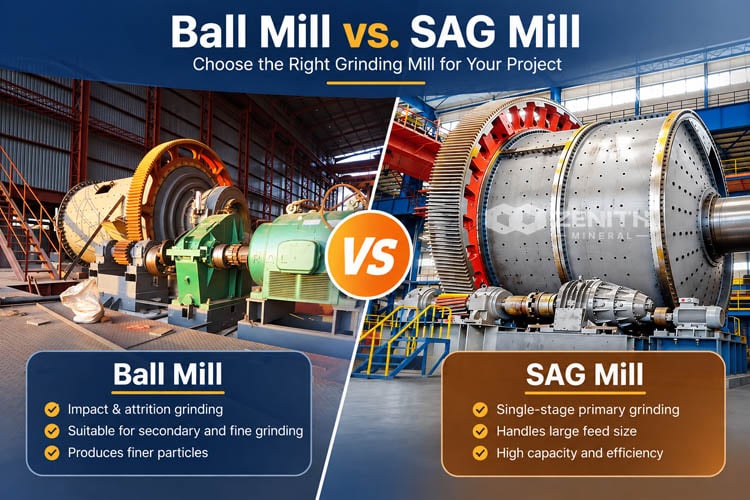
In mineral comminution, Ball mills and SAG (Semi-Autogenous Grinding) mills represent the most widely used grinding combination in modern mining plants. Ball mills serve as secondary and tertiary fine grinding units, utilizing a dense steel ball charge (30–45% volume) to grind feed below 25 mm down to fine mineral liberation sizes (< 0.074 mm / 200 mesh) required for flotation, gravity concentration, or leaching circuits. SAG mills function as primary coarse grinding units, taking large Run-of-Mine (ROM) ore up to 300 mm and reducing it to 1–3 mm using self-grinding ore rocks supplemented by a low steel ball charge (4–15%).
What is a Ball Mill?
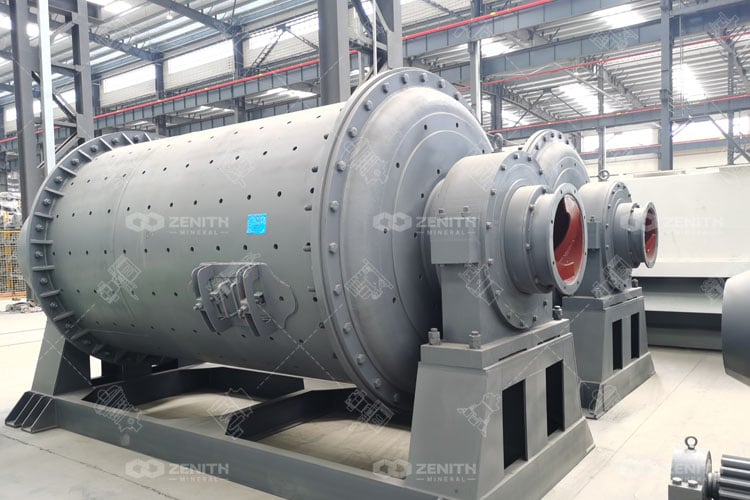
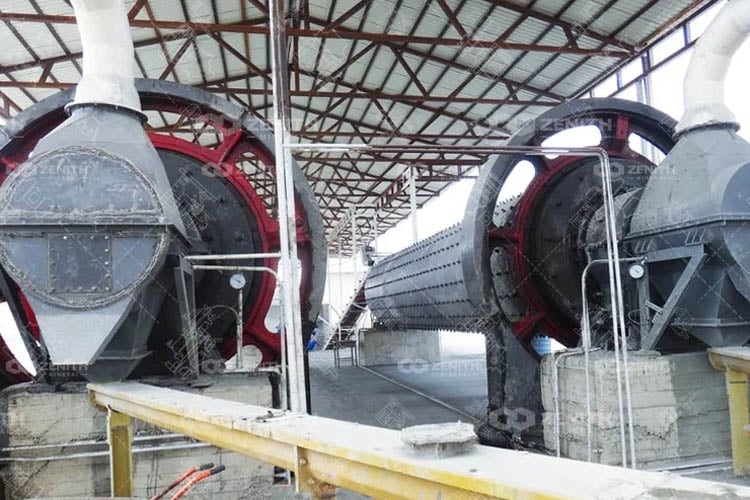
A Ball mill is a versatile secondary and tertiary fine grinding machine designed to liberate valuable minerals from surrounding gangue rocks. It operates by rotating a heavy cylindrical shell filled with dense steel or alloy grinding balls (occupying 30% to 45% of total mill volume). As the mill rotates, cascading steel balls impact and attrite smaller feed particles (typically under 25 mm) down to fine powders below 0.074 mm (200 mesh / 74 microns), preparing the slurry for downstream mineral processing such as flotation, gravity concentration, or leaching.
What is a SAG Mill?
A SAG mill (Semi-Autogenous Grinding mill) is a primary comminution unit widely used in high-capacity mining operations to perform coarse ore reduction. Unlike traditional tumbling mills, a SAG mill uses the incoming hard rock ore itself as the primary grinding medium (autogenous grinding), supplemented by a low charge of forged steel balls (typically 4% to 15% of mill volume). Operating with a large diameter and short axial length, SAG mills handle massive Run-of-Mine (ROM) feed rocks up to 300 mm, eliminating the need for complex secondary and tertiary crushing plants.
Ball Mill vs. SAG Mill Technical Comparison Table
The table below outlines the core mechanical, operational, and performance parameters distinguishing Ball mills from SAG mills in metallic and non-metallic mineral grinding operations:
| Technical Parameter | Ball Mill | SAG Mill |
|---|---|---|
| Circuit Role | Secondary & Tertiary Fine Grinding | Primary Grinding (Replaces 2nd & 3rd crushing stages) |
| Maximum Feed Size | < 15 – 25 mm (Requires pre-crushed/SAG product) | Up to 200 – 300 mm (Direct Run-of-Mine ore) |
| Product Fineness | 0.044 – 0.2 mm (70 – 325 mesh / < 74 microns) | 1 – 3 mm (Coarse discharge) |
| Grinding Media Charge | High-density 30–45% steel/alloy ball volume | Coarse ore rocks + 4–15% steel ball volume |
| Aspect Ratio (Diameter vs. Length) | Smaller Diameter, Long Length | Large Diameter, Short Length |
| Liner Material & Wear Profile | High-manganese steel / Rubber / Cr-Mo steel liners | Heavy-duty alloy steel / rubber-composite lifter bars |
| Operating Circuit Type | Closed circuit with Hydrocyclones / Vibrating Screens | Open circuit or closed circuit with Pebble Crusher |
| Primary Application | Fine liberation for flotation, leaching, and magnetic separation | Gold, Copper, Iron Ore, Molybdenum megaprojects |
Key Differences Between Ball Mill and SAG Mill
1. Grinding Mechanism & Media Action
- Ball Mill Mechanism: Ball mills rely on a dense charge of smaller steel grinding media (25‑90 mm diameter) operating in a high‑speed tumbling motion. The grinding action is driven by high‑frequency impact (cascading) and friction/abrasion (cataracting), ensuring fine liberation of target minerals.
- SAG Mill Mechanism: SAG mills rely heavily on autogenous grinding, where large tumbling rocks cascade inside the rotating drum to crush themselves upon impact. A small charge of large steel forged balls (100‑125 mm diameter) is added to shatter competent, hard rocks that resist self‑breakage.
2. Mill Shell Geometry & Aspect Ratio
- Ball Mill Design: Constructed with a longer shell relative to its diameter (cylindrical shape). The extended axial length increases the residence time of slurry inside the drum, ensuring consistent fine grinding down to 200 mesh.
- SAG Mill Design: Designed with a large diameter and a relatively short shell length (pancake shape). The large diameter creates a high drop height, generating the immense kinetic impact energy needed to fracture 300 mm boulders.
3. Product Particle‑Size Distribution
Particle‑size spread is a critical practical distinction for downstream separation circuits.
- Ball Mill: Produces narrow, well‑controlled fine particle distributions. Operated in closed‑circuit configuration with hydrocyclones, ball mills reliably deliver consistent P80 fineness required for flotation, leaching or magnetic separation. Operators can tune output fineness by adjusting ball grading, mill speed and cyclone cut‑points.
- SAG Mill: Generates a much broader particle‑size spectrum, containing coarse pebbles, intermediate fractions and a portion of fines. SAG discharge almost never meets final liberation requirements, and must go through additional pebble crushing and secondary ball‑milling stages before mineral separation.
4. Ore Competence & Feed‑Material Sensitivity
- Ball Mill: Shows stable performance across medium‑hard to hard ore types. Its operation is far less sensitive to minor fluctuations in feed hardness or particle composition, provided incoming feed stays below the maximum allowable 15‑25 mm size limit.
- SAG Mill: Highly dependent on ore competence. It works best with competent, hard ore that can act as self‑grinding media. Soft, clay‑rich or friable feed material leads to excessive fines generation, unstable mill load and sharp throughput drops. SAG performance degrades significantly when feed size distribution varies widely.
5. Operational Flexibility & Process Tuning
- Ball Mill: Offers wide operational adjustability. Plant operators can modify grinding‑ball gradation, mill filling ratio, pulp density and hydrocyclone classification set‑points to adapt to changing ore conditions and target different finished fineness grades. Both wet‑grinding and dry‑grinding modes are available.
- SAG Mill: Tuning options are comparatively limited. Performance is constrained by ore properties. Major adjustments involve changing ball volume percentage, feed blend and mill speed. SAG mills are predominantly run under wet‑grinding conditions for mineral‑processing applications.
6. Wear Components and Maintenance Requirements
- Ball Mill: Standardized liners and grinding balls are widely available globally. Liner structures are relatively compact. Maintenance tasks include periodic ball replenishment and scheduled liner change‑outs; many repair jobs can be completed with standard site tools. Media consumption ranges roughly from 0.8‑1.5 kg per ton of ore processed.
- SAG Mill: Equipped with heavy‑duty large‑size lifter‑bar liners that absorb severe rock‑on‑rock impact. Liner replacement demands special heavy‑lifting equipment and longer shutdown windows. Although steel‑ball consumption is lower (0.3‑0.6 kg/t), replacement parts are high‑cost custom components, and spare‑part lead‑times can be long.
7. Capital Expenditure (CAPEX) vs. Operational Footprint
- Ball Mill Advantage: Ball mills deliver lower grinding‑ball consumption per ton on fine feed, providing predictable power draw and higher operational reliability in fine‑grinding circuits. Individual ball‑mill units have lower unit CAPEX and can be modularly scaled by adding multiple smaller mills. However, the full circuit still requires complete upstream multi‑stage crushing facilities.
- SAG Mill Advantage: Installing a SAG mill drastically simplifies the plant layout by replacing multi‑stage secondary/tertiary cone crushers, screening buildings, and conveyor networks, significantly reducing civil footprint and installation timeline. Nevertheless, large‑diameter SAG mills often adopt expensive gearless motor drives, pushing up initial equipment and foundation investment substantially.
8. Power Supply and Site Infrastructure Constraints
- Ball Mill: Individual units feature moderate installed power ratings. For remote sites with limited grid capacity, multiple smaller ball‑mill modules can be phased‑in to match available power resources.
- SAG Mill: Single SAG units draw extremely high power. Mine sites must prepare robust power‑transformer infrastructure to accommodate peak motor load, which adds extra civil‑engineering investment for green‑field mining projects.
How Ball Mills and SAG Mills Work Together in SABC Circuits
Rather than competing, Ball mills and SAG mills are most effective when paired together in an SABC (SAG Mill, Ball Mill, Pebble Crusher) grinding circuit, which represents the industry standard for high-capacity modern mining plants:
- Primary Stage (SAG Mill): Run-of-Mine (ROM) ore from the primary jaw or gyratory crusher is fed directly into the SAG mill.
- Pebble Crushing Stage: Oversized critical-size rocks (pebbles ~25–50 mm) discharging from the SAG mill are recycled to a cone crusher (Pebble Crusher) and returned to the SAG mill.
- Secondary Stage (Ball Mill): The fine slurry overflow from the SAG mill screen flows into a hydrocyclone sump. The hydrocyclone underflow feeds the Ball mill for final fine grinding, while the cyclone overflow proceeds directly to flotation or leaching.
Frequently Asked Questions
Q: What is the main difference between a Ball mill and a SAG mill?
A: The main difference lies in their grinding stage and media charge. A Ball mill is a secondary or tertiary fine grinding unit that uses a heavy charge of steel balls (30–45% volume) to reduce fine feed rocks (< 25 mm) down to fine powders below 0.074 mm (200 mesh) for flotation or leaching. A SAG (Semi-Autogenous Grinding) mill is a primary grinding unit that uses large incoming ore rocks mixed with a small charge of steel balls (4–15% volume) to reduce Run-of-Mine (ROM) ore directly from up to 300 mm down to 1–3 mm.
Q: Why are Ball mills and SAG mills used together in an SABC circuit?
A: Ball mills and SAG mills are paired in an SABC (SAG Mill, Ball Mill, Pebble Crusher) circuit to optimize grinding energy and operational footprint. The SAG mill eliminates expensive multi-stage secondary and tertiary crushing by accepting large ROM ore, while the Ball mill efficiently handles the fine secondary grinding to liberate valuable minerals.
Q: Can a Ball mill replace a SAG mill in mineral processing?
A: No, a Ball mill cannot directly replace a SAG mill because Ball mills cannot accept coarse Run-of-Mine (ROM) ore larger than 25 mm. Feeding large rocks into a Ball mill causes liner damage and severe ball breakage. However, if a plant installs a full multi-stage crushing plant (Primary + Secondary + Tertiary Crushing), Ball mills can process the fine product without a SAG mill.


 24/7 Online