Sand is one of the most widely used materials in the construction industry. It is an essential component of concrete, mortar, plaster, masonry, road construction, paving, drainage, and backfilling. However, not all sand has the same particle size, shape, cleanliness, or performance.
The main types of sand used in construction include river sand, manufactured sand (M-sand), concrete sand, pit sand, masonry sand, plastering sand, fill sand, and crushed stone sand. Some categories overlap because construction sand can be classified by its source, particle size, processing method, or intended application.
For structural concrete, the quality of fine aggregate is particularly important. ASTM C33/C33M recognizes both natural sand and manufactured sand as fine aggregate for concrete and specifies requirements related to grading and material quality.
The best sand for a construction project therefore depends not simply on whether it is “fine” or “coarse,” but on its particle size distribution, particle shape, cleanliness, mineral composition, moisture condition, and intended use.
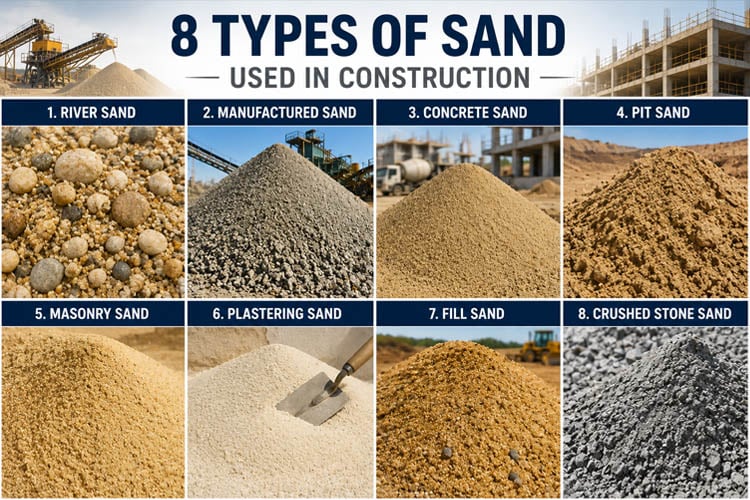
Construction sand is a granular material used as fine aggregate or as a filling and bedding material in construction applications.
It can come from:
Construction sand is commonly used in:
The important point is that “construction sand” is an application term rather than one specific type of material.
For concrete, for example, ASTM C33/C33M requires fine aggregate to meet specified grading and quality requirements, rather than simply accepting any material that looks like sand.
The most common types include:
| Type of Sand | Typical Source | Main Applications | Key Characteristics |
|---|---|---|---|
| River Sand | Rivers and alluvial deposits | Concrete, mortar, plastering | Naturally rounded, workable |
| Manufactured Sand (M-Sand) | Crushed rock | Concrete, mortar, infrastructure | Controlled grading, angular particles |
| Concrete Sand | Natural or processed source | Concrete, foundations, slabs | Medium to coarse, clean |
| Pit Sand | Inland deposits | Concrete, mortar, masonry | Relatively coarse and angular |
| Masonry Sand | Processed natural or manufactured sand | Brickwork, blockwork, mortar | Fine and workable |
| Plastering Sand | Natural or processed source | Plastering, rendering | Fine, clean, smooth finish |
| Fill Sand | Natural deposits or processed material | Backfilling, leveling | Economical and compactable |
| Crushed Stone Sand | Crushing plants | Road works, concrete, manufactured sand | Angular, controlled by processing |
These names are not universal classifications. The specifications and commercial names used for sand can vary between countries, suppliers, and construction standards.
River sand is naturally deposited by rivers and streams. Continuous water movement and abrasion generally produce relatively smooth and rounded particles.
River sand may be used for:
Its rounded particle shape can contribute to good workability in mortar and concrete. However, the actual suitability of river sand must be determined by testing its grading and cleanliness.
Another consideration is availability. In some regions, restrictions on natural sand extraction and concerns about river ecosystems have increased interest in manufactured sand.
Important: River sand should not automatically be considered better than manufactured sand. The performance of either material depends on whether it meets the requirements of the intended application.
Manufactured sand, commonly called M-sand, is produced by crushing and processing hard rock rather than extracting naturally deposited sand.
Typical source rocks include:
A typical M-sand production process may include:
Primary crushing → Secondary crushing → Fine crushing or VSI shaping → Screening → Washing/classification
Modern M-sand screening utilizes multi-deck vibrating screens with high-frequency meshes (typically 4.75 mm for concrete sand separation and 75 µm / 200 mesh for de-dusting) to achieve precise aggregate gradation and control silt content below statutory limits.
Manufactured sand is increasingly important where natural sand is scarce, expensive, environmentally restricted, or inconsistent in quality.
ASTM C33/C33M specifically recognizes manufactured sand as a form of fine aggregate for concrete, provided it meets the applicable grading and quality requirements.
M-sand can be used for:
However, not every crushed-rock fine is automatically suitable as M-sand. The crushing process, particle shape, gradation, and amount of deleterious or excessive fines must be controlled.
Concrete sand is a relatively coarse, clean sand designed for use as fine aggregate in concrete mixtures.
It is generally coarser than sand intended for plastering or fine finishing.
A suitable concrete sand needs appropriate grading and cleanliness. ASTM C33/C33M specifies requirements for the grading and quality of fine aggregate used in concrete.
Concrete sand is often screened and, depending on the source, washed to control:
The exact grading requirements should always follow the applicable project specification or local standard.
Pit sand is naturally extracted from inland deposits rather than riverbeds. It is sometimes called coarse sand or P-sand, although terminology varies by market.
Pit sand often has relatively angular particles compared with river sand.
Pit sand can be used in:
However, raw pit sand may require screening or washing before use, particularly when clay or excessive fines are present.
Masonry sand is a fine, clean sand primarily used to produce workable mortar for brick and block construction.
Compared with concrete sand, masonry sand is generally finer and is selected for its workability and finishing characteristics.
The sand should be sufficiently clean and appropriately graded so that the mortar can spread easily while maintaining the required performance.
Plastering sand is fine sand selected for plastering, rendering, and surface-finishing applications.
The ideal characteristics depend on the plaster specification, but excessive coarse particles and contaminants can make achieving a smooth finish more difficult.
For plastering, particle size and cleanliness are particularly important because they affect:
A sand that is suitable for structural concrete is not necessarily the best choice for a smooth plaster finish.
Fill sand is primarily used for filling, leveling, and backfilling rather than high-performance structural concrete.
It may contain a wider range of particle sizes than concrete or masonry sand.
Fill sand is valued primarily for its ability to provide economical filling and compaction.
It should not be substituted for specified concrete or masonry sand unless the relevant engineering specification allows it.
Crushed stone sand is produced from the fine fraction generated when rock is mechanically crushed and screened.
Depending on the production process, it may be further processed to improve its suitability for construction.
Typical processing may include:
Crushing → Screening → Fine crushing/VSI shaping → Washing or classification
Crushed stone sand is particularly important for quarry operators because it can turn fine rock material into a saleable product instead of treating it simply as waste.
This is one of the most common questions when selecting construction sand.
| Feature | River Sand | M-Sand |
|---|---|---|
| Source | Natural river/alluvial deposits | Crushed rock |
| Particle shape | Generally rounded | Generally angular/cubical |
| Production | Natural deposition and extraction | Manufactured by crushing and screening |
| Grading control | Depends on deposit and processing | Can be controlled during production |
| Quality consistency | Depends on source | Can be highly consistent with proper processing |
| Scalability | Limited by natural deposits | Production can be expanded with equipment |
| Environmental considerations | Extraction can affect river systems | Uses quarry rock and processing energy |
| Typical uses | Concrete, mortar, plastering | Concrete, mortar, infrastructure |
The differences between manufactured sand and river sand important conclusion is:
M-sand is not simply a lower-quality substitute for river sand. Properly produced manufactured sand can meet specified requirements for concrete and other construction applications.
ASTM C33/C33M explicitly permits natural sand, manufactured sand, or a combination of the two as fine aggregate for concrete, subject to the applicable requirements.
Several factors are increasing interest in manufactured sand.
Yes, in many construction applications, manufactured sand can replace natural sand when it is properly produced and meets the required specifications.
The key is not the name “M-sand,” but its actual properties.
A suitable M-sand should have controlled:
In some concrete applications, a blend of manufactured sand and natural sand may also be used to achieve the desired grading and workability.
Fine sand and coarse sand differ mainly in particle size, making them suitable for different construction applications.
Fine sand generally has smaller particles and is commonly used where smoothness and workability are important.
Typical applications:
Coarse sand contains relatively larger particles and is commonly preferred for applications requiring appropriate aggregate grading and structural performance.
Typical applications:
However, particle size alone does not determine performance. Particle-size distribution, shape, surface texture, cleanliness, and mineral properties also matter.
FHWA guidance notes that the shape and surface characteristics of fine aggregate can affect void content and water demand in concrete. Highly angular particles with irregular surfaces can require more paste or water to achieve comparable workability.
For concrete, the best sand is clean, properly graded fine aggregate that meets the applicable project specification.
Depending on the region and available materials, this could be:
ASTM C33/C33M requires consideration of grading and quality rather than simply classifying sand by its source. It also addresses impurities, soundness, clay lumps, organic impurities, and potentially reactive materials.
For plastering, a clean, fine, well-graded sand is generally preferred because it provides good workability and a smoother finish.
Common choices include:
Extremely coarse sand can produce a rough surface, while excessive fines or clay can increase shrinkage and affect bonding.
The ideal material should therefore be selected according to the plaster mix design and local construction specification.
Masonry sand or another clean, appropriately graded fine sand is commonly used for brick and block mortar.
The most important properties include:
The objective is to produce mortar that is easy to spread and provides the required bond and durability after curing.
Road construction uses several different types of sand and fine aggregate depending on the layer and specification.
Possible materials include:
For road projects, material selection should be based on the engineering specification for the particular layer rather than using a generic “construction sand.”
| Construction Application | Commonly Suitable Sand |
|---|---|
| Structural concrete | Concrete sand, M-sand, approved natural sand |
| Ready-mix concrete | Properly graded natural or manufactured sand |
| Plastering | Plastering sand, fine river sand, suitable masonry sand |
| Brickwork | Masonry sand |
| Block production | Masonry sand, M-sand, suitable fine aggregate |
| Road construction | Manufactured sand, crushed stone sand, specified natural sand |
| Backfilling | Fill sand |
| Pipe bedding | Suitable fill or bedding sand |
| Manufactured sand production | Processed crushed rock |
Always follow the engineering specification for the actual project. A sand that works well for plastering may not meet the requirements for structural concrete, and a fill sand should not automatically be used as fine aggregate.
Regardless of the name given to the material, several properties are important.
A good construction sand should have a grading appropriate for its intended application.
Poor grading can increase voids and affect:
Sand particles may be:
Particle shape influences packing, interlocking, surface area, and water demand.
For concrete, highly irregular particles may increase water demand and make the mix more difficult to place.
Sand may contain:
Excessive contaminants can negatively affect concrete or mortar performance.
This is why recognized aggregate specifications include tests for impurities and other potentially harmful materials.
The moisture content of sand affects the amount of water actually entering a concrete or mortar mix.
Two sands with identical dry gradations can behave differently during batching if their moisture conditions are different.
The source rock matters.
Certain minerals can affect:
For critical concrete applications, the sand should therefore be tested rather than selected solely by appearance.
Manufactured sand is normally produced through a controlled crushing and screening process.
A typical production line is:
Raw Rock → Primary Crusher → Secondary Crusher → Fine Crusher/VSI → Vibrating Screen → M-Sand
Depending on the raw material and product requirements, the process may also include:
A VSI crusher can help reshape crushed particles and produce a more cubical product.
This is useful when the objective is to produce high-quality manufactured sand with controlled particle shape.
However, a VSI is not automatically required for every sand-production plant. The optimal equipment depends on:
The most common types include river sand, manufactured sand (M-sand), concrete sand, pit sand, masonry sand, plastering sand, fill sand, and crushed stone sand. These categories overlap because sand is classified by its geological source, particle size, and intended application.
Clean, coarse, and properly graded natural sand or manufactured sand (M-sand) is ideal for concrete. ASTM C33/C33M recognizes both natural and manufactured sand as fine aggregates for concrete, provided they meet specified grading and durability requirements.
Not necessarily. M-sand offers highly consistent grading, higher compressive strength, and controlled production, while river sand provides naturally rounded particles and excellent workability. The better option depends on local availability, environmental restrictions, and project specifications.
Fine sand (0.075 mm–1.18 mm) contains smaller particles and is primarily used for wall plastering, rendering, and smooth masonry mortar. Coarse sand (1.18 mm–4.75 mm) has larger particles required for load-bearing structural concrete, foundations, and heavy bedding layers.
Clean, fine-to-medium sand with low silt content (<3%) is best for plastering and bricklaying. Masonry sand or fine river sand provides the required workability and smooth spreading properties needed to prevent shrinkage cracks after drying.
The different types of sand used in construction are not interchangeable. River sand, M-sand, concrete sand, pit sand, masonry sand, plastering sand, fill sand, and crushed stone sand each have different characteristics and applications.
The right choice depends on more than particle size. Grading, particle shape, cleanliness, moisture content, mineral composition, and the final application all influence sand performance.
For concrete and other structural applications, the safest approach is to select sand according to the relevant engineering specification and verify its properties through testing. ASTM C33/C33M, for example, establishes grading and quality requirements for fine and coarse aggregates used in concrete and recognizes both natural and manufactured sand as fine aggregate.
For quarry owners and aggregate producers, the growing use of manufactured sand (M-sand) also creates an opportunity to turn suitable crushed rock into a consistent, higher-value fine aggregate through a properly designed crushing, shaping, screening, and washing process.


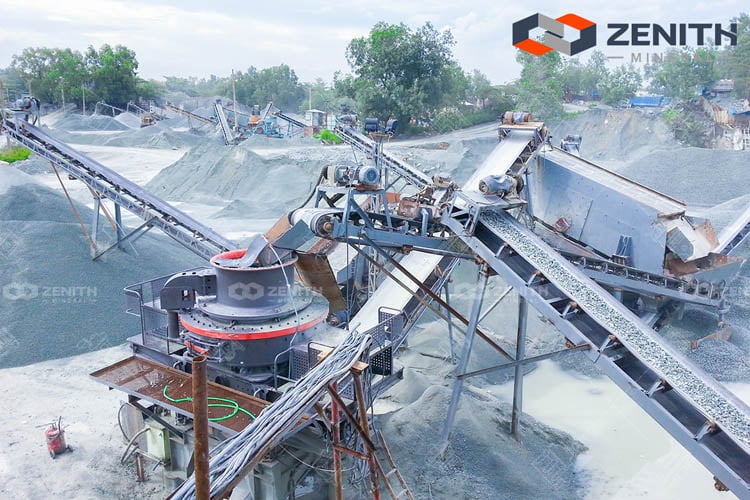
For large-scale projects requiring high-quality manufactured sand, the Vertical Shaft Impact (VSI) crusher and the VU Tower-type Sand Making System are recommended.
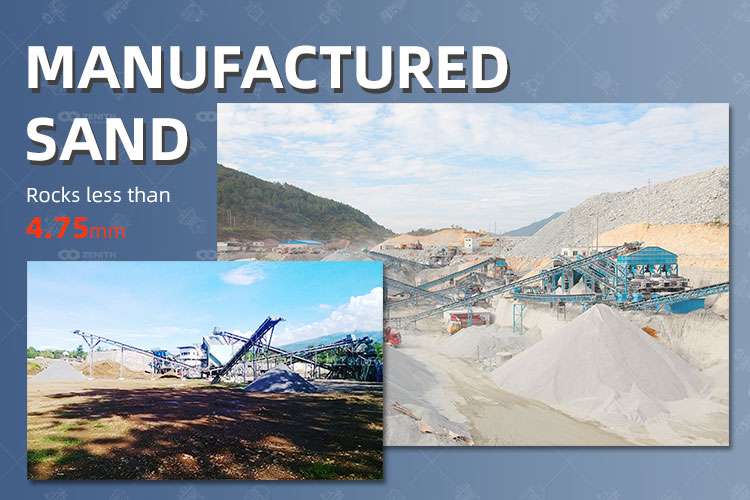
Manufactured sand refers to rock, mine tailings, or industrial waste particles with a particle size of less than 4.75mm. Replacing natural sand with manufactured sand has become an inevitable trend in industry development.
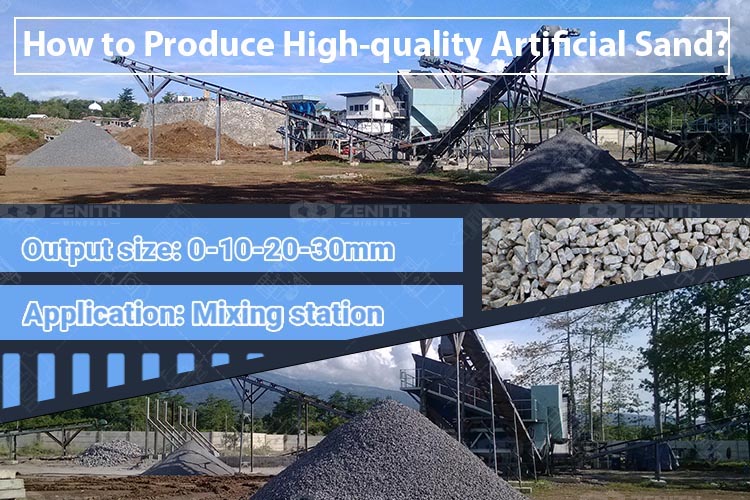
Developing high-quality machine-made sand with stable output capacity and quality to replace river sand can not only solve the imbalance between supply and dema
Fill your requirements here, and we'll send the custmized solution and quotation to you by the reserved contact information.
Copyright ©2000-2026 SHANGHAI ZENITH MINERAL CO.,LTD.

 WhatsApp




 24/7 Online